

Introduction
Safety warning: “Autumn crocus” is a common name that can refer to different plants. The culinary saffron crocus is Crocus sativus, while Colchicum autumnale and other Colchicum species are poisonous and should never be used as saffron. Never determine that a plant is edible from a common name, flower color, or photograph alone. Only harvest plant material that has been positively identified as food-intended Crocus sativus.
Two Unrelated Fall-Flowering Plants
Saffron Crocus: Crocus sativus
- Belongs to the iris family, Iridaceae.
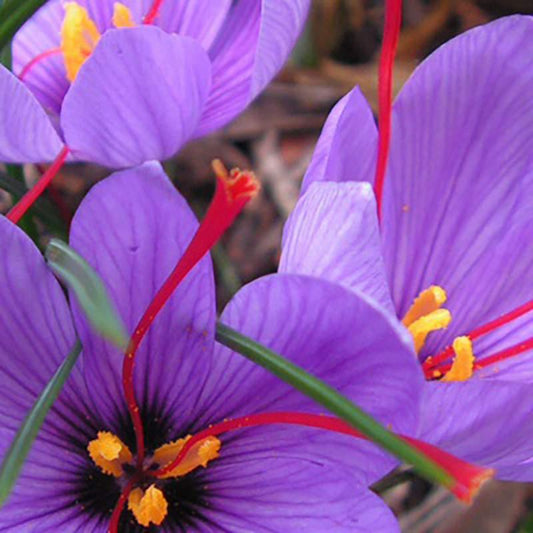
- Each flower has three stamens and three long, red-orange stigmas. The dried stigmas are the saffron spice.
- Narrow, grass-like leaves typically emerge around the flowering period and may develop before or after the flowers.
- Only material from correctly identified, food-intended Crocus sativus should be harvested.

Meadow Saffron or Autumn Crocus: Colchicum autumnale
- Belongs to the family Colchicaceae, not the iris family.
- The flowers have six stamens, compared with three stamens in Crocus. This is a useful botanical identification characteristic, but it should not be treated as a stand-alone test for whether a plant is safe to eat.
- Broad leaves usually emerge in spring and die back before the leafless fall flowers appear.
- All parts of Colchicum plants are poisonous to humans and animals. They contain the toxic compound colchicine, and Colchicum must never be used as a substitute for culinary saffron or eaten as food.
Why Flower-Part Counts Are Not Enough
Stamen count and leaf timing can provide useful botanical clues, but they should not be used alone to decide whether a plant is edible. Crocus and Colchicum can look similar, and common names such as “autumn crocus” and “meadow saffron” can be misleading.
Other fall-flowering bulbs and corms also exist, so keep the original botanical label with every planting, store corms in separate labeled containers, and never mix ornamental corms with food crops. Never consume a plant when its identity is uncertain.
Growing and Harvesting Saffron Safely
- Buy corms clearly labeled Crocus sativus from a reputable, traceable supplier.
- For saffron production, plant Crocus sativus in a clearly marked area with full sun and well-drained soil. Keep the planting separate from ornamental bulbs and corms, and retain the original botanical label.
- Keep children and pets away from unidentified bulbs, corms, and harvested plant material.
- Harvest only the three red stigmas from positively identified Crocus sativus flowers. If labels are lost, plantings become mixed, or the plant's identity is uncertain, do not consume the harvest.
- Discard any harvest if labels were lost, plantings became mixed, or identification is uncertain.
See our guide to harvesting saffron crocuses and review the current saffron crocus product listing before planting.

If Someone May Have Eaten Colchicum
If someone may have eaten Colchicum, do not wait for symptoms to appear and do not induce vomiting unless specifically instructed to do so by a medical professional or poison center.
In the United States, contact Poison Control immediately at 1-800-222-1222 or use the POISON CONTROL online tool. If the person collapses, has a seizure, has trouble breathing, or cannot be awakened, call 911. Outside the United States, contact the local poison center or emergency service. For suspected pet exposure, contact a veterinarian or appropriate animal poison service promptly.
When in doubt, don't eat it. The safest way to avoid confusion is to keep saffron production and ornamental bulb plantings clearly labeled and separate, and to rely on confirmed botanical identification rather than common names or appearance alone.
Conclusion
The key to avoiding autumn crocus confusion is simple: rely on the plant's botanical identity, not a common name or appearance alone. Crocus sativus is the saffron-producing crocus, while Colchicum species such as Colchicum autumnale are poisonous and should never be harvested or used as culinary saffron. When growing saffron, keep Crocus sativus clearly labeled and separate from other ornamental bulbs and corms, and never consume plant material if its identity is uncertain.
If your goal is simply to bring seasonal color to your garden, fall-planted flower bulbs offer many ornamental possibilities beyond saffron production. Explore Grow Organic's Fall-Planted Flower Bulbs collection to find options for your landscape, and be sure to follow the specific planting, growing, and care requirements for each variety.
Authoritative Identification and Safety References
- Colorado State University Extension: Edible Flowers— guidance on proper identification of edible flowers and the risks of confusing common names.
- University of Wisconsin–Madison Division of Extension: Autumn Crocus (Colchicum spp.)— information on distinguishing Crocus from Colchicum, including flower characteristics, foliage, and toxicity.
- Penn State Extension: Saffron: A Tale of Red Gold and How to Produce Your Own— information on Crocus sativus, saffron stigmas, corms, and growing conditions.
- Penn State Extension: The Unexpected Delight of Fall-Blooming Bulbs— information on fall-flowering crocuses, Colchicum, and other fall-blooming bulbs.
- Royal Horticultural Society: Colchicum— botanical information, seasonal growth, and toxicity of Colchicum.
- Poison Control: First Aid Guidelines— guidance for suspected plant poisoning, including when to contact Poison Control and when to call 911.


8 comments
Teri, you should not have to give them a cold treatment before planting.
I just purchased some of these bulbs and received them. Do you have to give them a ‘winter’ in the refrigerator before planting them?
thanks
Jean, you can always put some bird netting over the plants to keep the cats out of them.
Hi there,
I’ve just invested in 100 Crocus Sativus bulbs and 100 white crocus Jeanne D’Arc and only now reading online that these may be poisonous to my cats? Any suggestions as to where I can plant them?
With thanks, Jean
Pretty easy solution [ Only harvest the THREE LONG RED STYLES ] All other crocuses have white-yellow styles and/or less than three.
Saffron is gathered during Autumn from the long red stigma/styles of Crocus sativus, these are part of its female reproductive organs. Not from the stamens as is often said.