Introduction
A spreader can help you sow seeds and feed your garden. But the wrong setting can leave bare spots or drop too much fertilizer in one place.
Learning how to calibrate a garden spreader takes out the guesswork. To calibrate means to check how much it drops over a measured space. You need a scale, a tape measure, and the product label.

Choose a Spreader for Your Space
There are two main types of spreaders for dry seed and fertilizer. Choose one that fits your yard and the material you plan to use.
What Is a Broadcast Spreader?
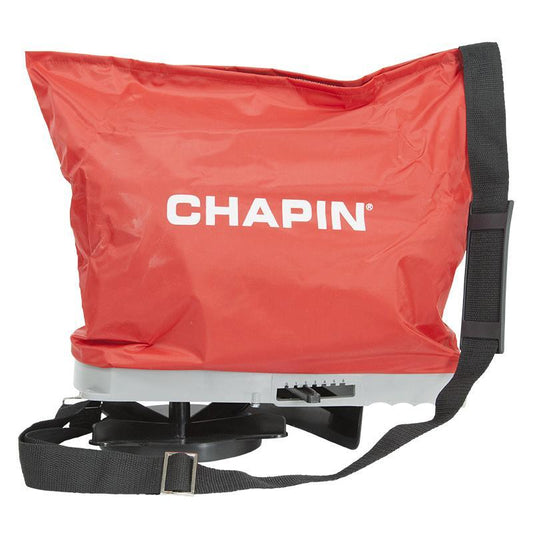
A broadcast spreader has a spinning plate that throws material outward. Its wide reach helps cover large lawns. Handheld spreaders suit smaller spaces.
Searching “lawn spreaders broadcast spreader” can bring up many models. Check the controls and hopper size before buying. The hopper is the bin that holds the material.
The best broadcast spreader for lawns should spread evenly at a pace you can maintain.
What Is a Drop Spreader?
A drop spreader drops material straight down beneath its bin. It gives more control near a flower bed, but you must line up each pass to avoid gaps.
A compost spreader handles bulky compost. Do not assume it can also measure small seeds or fertilizer well.
How to Calibrate Your Spreader
Fertilizer spreader calibration checks how much feed reaches the ground. Seed spreader calibration does the same for seed.
Test each material on its own. A granular product may flow differently from seed or pellets. Our guide to fertilizer forms explains these differences.
Step 1: Check the Spread Width
Follow your manual to check where the material lands. With rotary models, shallow, matching trays placed across the spread path help show the pattern.
Less material often lands at the outer edges. Nearby passes must overlap to fill those thin spots.
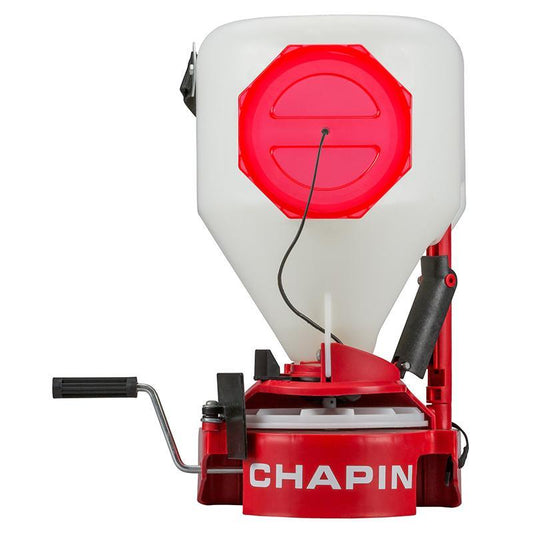
Use the checked spacing between passes as your working width. Do not use the farthest distance a few particles travel. Keep your walking speed steady. On hand-cranked models, turn the handle at a steady pace too.
Step 2: Measure a Test Area
Multiply working width by travel distance. For example, a 5-foot working width over 20 feet gives a test area of 100 square feet.
Close the gate, weigh your material, then fill the spreader. Test over clean tarps wide enough to catch the full throw. This lets you collect the material without feeding the same patch several times.
Walk the marked distance. Open the gate while moving and close it before you stop.
Step 3: Weigh What Remains
Subtract the weight left in the hopper from the starting weight. This tells you the amount of product released.
Then use this formula:
Pounds released ÷ square feet tested × 1,000 = pounds per 1,000 square feet.
Compare the result with your target application rate. These sample rates show the math only:
| Material | Example rate per 1,000 square feet | Target for 100 square feet |
|---|---|---|
| Fertilizer | 4 pounds | 0.4 pound |
| Seed | 3 pounds | 0.3 pound |
The amount of fertilizer means the weight of the whole product, not just its nitrogen.
Before sowing, plan your fall cover crop. Use its stated rate for broadcast sowing.
Step 4: Adjust and Test Again
If too much comes out, reduce the opening. If too little comes out, increase it. Test again to check the flow rate.
Keep this simple record:
Product ___ | Width ___ | Distance ___ | Weight used ___ | Rate ___ | Setting ___

How to Use a Fertilizer Spreader
Keep the same pace while applying product. Close the gate before turns and stops.
For two passes at right angles, set each pass to deliver half the total rate. Half the dial number may not give half the output.
Keep granular fertilizers dry. Clear spills and clean the tool after use. Even the best lawn fertilizer spreader needs care to stay accurate.
Products for the Job
When comparing fertilizer spreaders for lawns, check which materials each model accepts. Browse our seed spreaders and choose all-purpose fertilizers based on your soil and crop needs.
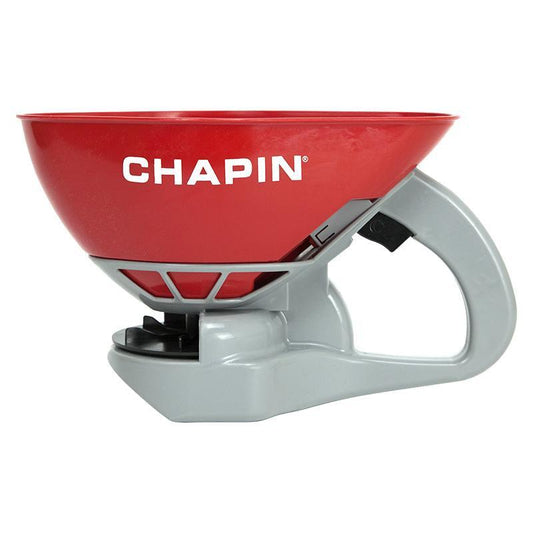
- Chapin Hand Crank Spreader: This 1.6-liter grass and fertilizer spreader suits a small area.
- Peaceful Valley Organics All Purpose Pelleted Fertilizer 4-3-2: An option where its nutrients are needed. Check the label and your tool’s pellet compatibility.
Start With a Small Test
Knowing how to use a spreader for fertilizer starts with a scale and a measured space. These checks help your spreader work well and reduce waste.
Conclusion
Calibrating your spreader before applying fertilizer or seed can help you achieve more even coverage and avoid unnecessary waste. Whether you are using a lawn care product such as fertilizer or grass seed, start by measuring the spread width and testing the spreader over a known area. Weigh the material used during the test and compare the application rate with the rate recommended on the product label.
Adjust the spreader setting as needed and repeat the test until the desired rate is achieved. Since different materials, including fertilizer grass seeds, can vary in weight, density, and particle size, calibrating the spreader for each product can improve application accuracy. A small test before each application can help make applying fertilizer more accurate and support healthy, consistent lawn and garden growth.