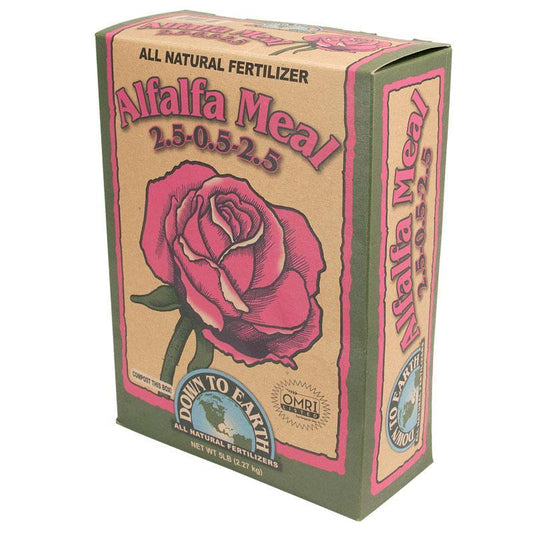
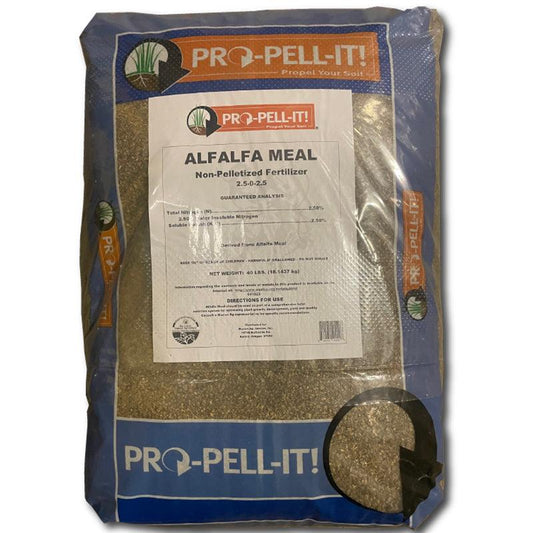
Alfalfa meal is made from dried, ground alfalfa plants. Gardeners use it as a plant-based fertilizer ingredient and soil amendment because it contributes organic matter and a modest amount of nutrients as it decomposes.
There is no single guaranteed analysis for every alfalfa meal product. Nutrient values, particle size, package size, application rate, and organic-use documentation can differ. Review the current label for the exact product rather than relying on a generic NPK value.
What Alfalfa Meal Contributes
Alfalfa meal commonly supplies some nitrogen along with smaller amounts of other nutrients. Its nutrients are released through decomposition, so availability depends on soil moisture, temperature, and biological activity.
- Adds plant-derived organic material
- Provides a slower nutrient contribution than many soluble fertilizers
- Can be incorporated into soil or used in compost when the product label allows
- Is available in different particle sizes and package sizes
Alfalfa meal is not automatically a complete fertilizer. Compare its guaranteed analysis with your soil-test results and the needs of the crop.
How to Apply Alfalfa Meal
- Review the product label and confirm that the intended crop or use is appropriate.
- Measure the treatment area rather than estimating by eye.
- Apply the labeled amount evenly.
- Incorporate or water the material as directed.
- Keep concentrated material away from direct contact with sensitive roots unless the label specifically allows that placement.
Avoid universal cup-per-plant or pounds-per-area recommendations because products and uses vary. When correcting a nutrient deficiency, begin with a soil test.
Garden Beds, Containers, Trees, and Compost
In garden beds, alfalfa meal may be incorporated before planting or applied as a labeled top-dressing. Containers have a smaller soil volume and can accumulate salts or excess nutrients more quickly, so use only a product and rate intended for container culture.
For trees and shrubs, place amendments according to label directions rather than concentrating them against the trunk. In compost, alfalfa meal is a nitrogen-containing feedstock; balance it with carbon-rich material and maintain appropriate moisture and aeration.
Organic Status and Product Selection
“Plant-based” and “natural” do not automatically mean that every product or package size is certified for organic production. If organic status matters, verify the current certifier documentation for the exact SKU and size.
When comparing alfalfa meal products, review:
- Guaranteed analysis
- Application directions
- Particle form and intended use
- Package size
- Current organic-use documentation
- Availability and shipping method
Frequently Asked Questions
Is alfalfa meal a complete fertilizer?
Not necessarily. Its analysis varies, and it might not provide all nutrients a crop needs. Use the guaranteed analysis and soil-test results to determine whether another input is necessary.
Can alfalfa meal be used around vegetables, flowers, and fruit trees?
Many labeled products include a range of garden uses, but the crop, placement, and rate should come from the current label.
When should alfalfa meal be applied?
Timing depends on the product and intended use. Because nutrient release requires decomposition, soil conditions influence how quickly nutrients become available.
Browse current options in the organic and natural fertilizer collection and verify the label for the exact product before applying.
When Alfalfa Meal Fits a Fertility Plan
Alfalfa meal is best treated as a low-analysis plant meal whose nutrients become available through decomposition. It may complement compost and other fertilizers, but it is not automatically a complete fertilizer for every crop. Compare its guaranteed analysis with soil-test results and nutrients already supplied by manure, compost, or blended products.
Release Rate and Timing
Moisture, temperature, particle size, and microbial activity influence decomposition. Apply early enough for the labeled use, but do not assume a fixed release date. In containers, use only when the product label supports that use and avoid crowding the limited root zone with excess organic material.
Measure and Record Applications
Calculate the labeled amount for the actual bed, row, or tree area; keep the material away from stems and trunks unless directed otherwise; and record the date and rate. Review the Organic Fertilizer Guide when comparing alfalfa meal with more concentrated nitrogen sources.
Related Fertilizer Guidance
Use this pillar as the primary guide for this fertilizer topic. Match the product analysis and labeled rate to the crop, soil conditions, and application method.