

This guide focuses specifically on planting shallot bulbs. For care through harvest and storage, use the complete shallot growing guide.
When to Plant Shallots
Plant in fall where winters are suitable for overwintering shallots. In very cold regions or where winter soil stays excessively wet, spring planting may be more reliable. Local extension guidance and the variety’s instructions should take priority over a universal date.
Prepare a Well-Drained Bed
Choose full sun and soil that drains readily. Loosen compacted soil and use a soil test to guide amendments. Avoid automatically adding phosphorus or heavy fertilizer when soil levels are already adequate.
Separate and Inspect the Bulbs
Gently separate planting bulbs if they arrive in clusters. Keep the papery wrapper intact when possible. Do not plant bulbs that are soft, moldy, badly damaged, or decaying.
Planting Orientation and Depth
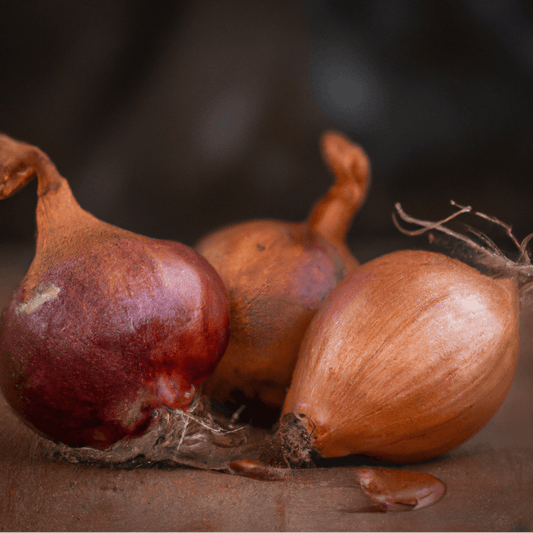
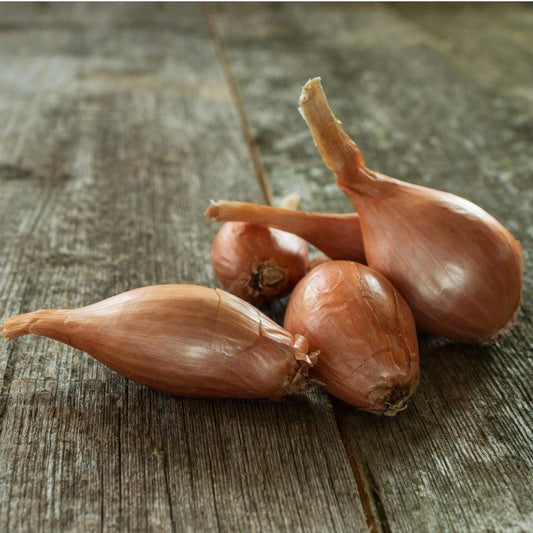
- Place each bulb root end down and pointed end up.
- Set it so the tip is near the soil surface, following the supplier’s depth directions and adjusting for erosion or frost heaving.
- Firm the soil gently without compacting it.
Spacing Shallot Bulbs
Allow roughly 6–8 inches between bulbs and about 10–12 inches between rows unless the variety or production system calls for another layout. Shallots multiply into clusters, so crowding can restrict bulb development and airflow.
First Watering and Mulch
Water after planting to settle soil around the roots, then irrigate according to soil moisture and weather. Shallots need moisture but are vulnerable in saturated soil. In cold climates, a loose mulch can moderate temperature and frost heaving; in wet climates, avoid creating a dense layer that holds water against emerging plants.
After Planting
Label varieties, keep weeds small, and check for heaving or drainage problems. Once growth is established, move to the pillar guide for feeding, irrigation, harvest, curing, and storage.
Planting Resources
Shallot Planting Resources
Continue with the complete shallot cultivation guide.



16 comments
Elizabeth, most areas can plant shallots in the fall. The shallots should be planted just deep enough so the little tag of the top just shows. If you watch our video on planting and growing garlic and shallots, Tricia demonstrates how to plant them. Here is the link for the video, https://www.groworganic.com/organic-gardening/videos/growing-onions-leeks-and-shallots.
Oop’s, I forgot to add, I planted them this spring. Should I have planted them in the fall, instead?
How deep should I have planted the seed shallots, which were at least twice the size of what i harvested?
Thanks again!
Liz Juvet
I’m reading all about shallots flowering, but mine never bloomed & the stalks died & dried up, without any regrowth.
I harvested them a couple of days ago, & they were all very small, not even 2" at best, but mostly under 1".
What did I do wrong? I had planted them in a wine barrel with good soil, lots of homegrown compost, worm castings & a small amount of chicken manure (aged & commercially purchased), & this is what I got.
My land is low, & last winter flooded, growing algae in the muck. I’ve never tried to grow shallots before, so am dismayed by the lack of yield.
Any & all help will be greatly appreciated!
Thank you!
Liz Juvet
Most of my red shallots bolted this year, but I still got a very good yield. I cut the tips off the flower stalks as soon as I saw them and then just left them alone. I have read that bolted shallots do not store as well, so we will see. I cured them for 4 weeks on a wire mesh before putting them in mesh bags.
Nan, you can leave the flower stalk, if the other stalks are dying, you can just fold over the flower stalk.