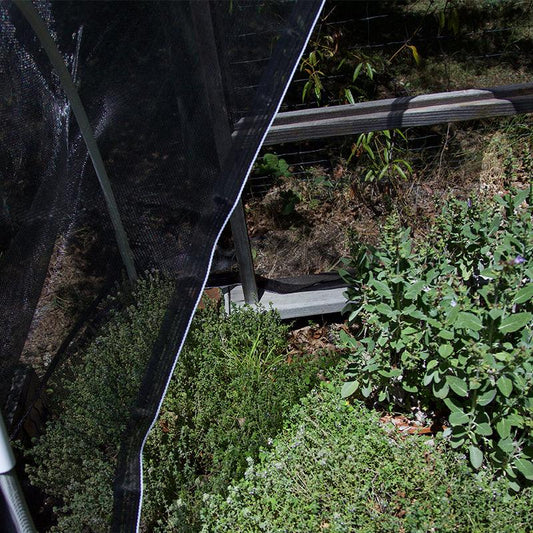
When a Southern California summer garden declines, separate heat and water stress from mites, whiteflies, aphids and ant activity before treating anything. Check root-zone moisture and overnight recovery, then inspect leaf undersides with magnification. Map where symptoms begin. Correct irrigation or shade failures, identify the organism, protect natural enemies, and escalate only when monitoring shows damage is increasing beyond what the crop can tolerate.
Use the Southern California summer plan to assess the whole garden. For emitter, shade, and salt evidence, use the drip-zoning guide. To decide whether a crop still merits the bed, use the heat-adapted crops and strategic rest guide. Diagnose and monitor before treating rather than following a preventive spray calendar.
Diagnose pest versus stress
Inspect affected plants and at least one apparently healthy comparison plant. Look at upper and lower leaf surfaces, growing tips, stems, nearby weeds and the soil moisture pattern. Note whether damage is concentrated beside a wall, at the dry end of a drip line, inside a dense humid canopy or on one crop family. Recheck during the cooler part of the day; a plant that regains turgor overnight differs from one that remains wilted in moist soil.
| Clue | Possible explanation | Confirmation step | First low-disruption response |
|---|---|---|---|
| Fine pale stippling, bronzing, tiny moving dots or webbing | Spider mites are possible | Inspect undersides with a hand lens; compare several leaves | Correct plant stress, remove badly infested expendable tissue where appropriate, monitor predators |
| Tiny pale adults flutter when foliage is disturbed; nymphs beneath leaves; honeydew | Whiteflies are possible | Inspect undersides and sticky residue; identify life stages | Remove heavily infested declining plants, control dusty stress, conserve natural enemies |
| Clusters of soft-bodied insects, curled growth, honeydew and ants | Aphids with ant tending are possible | Open curled leaves; trace ant routes and inspect for honeydew producers | Use a firm water stream where suitable, prune limited hotspots, block ant access where safe |
| Uniform midday wilt, dry root zone, recovery after cooling | Heat and water stress | Check soil at root depth and emitter flow | Repair distribution and reduce radiant load if indicated |
| Leaf margin burn with a wet or uneven root zone | Salt, root or water imbalance; not diagnostic alone | Review inputs, drainage and distribution; consider testing | Avoid speculative fertilizer or pesticide |
| Spots or collapse after humid weather, storm or prolonged wetness | Disease or weather injury | Compare pattern and signs with an institutional diagnostic resource | Improve airflow and sanitation without overwatering |
Regional patterns change the likely cause
Immediate coast and marine layer: Cooler conditions can slow mite development relative to hotter inland sites, while longer leaf wetness and dense canopies may complicate foliar disease. Do not add shade that traps humidity. Space plants for airflow, deliver water to roots, and inspect brassica successions for aphids, caterpillars and snails as well as mites, whiteflies, and ant-tended honeydew producers.
Coastal mesas: Wind and salt exposure can make foliage look pest-damaged. Check whether symptoms face the prevailing wind and whether insects or signs are actually present. Dust and water stress can still favor mites in protected pockets.
Inland valleys: Hot, dry conditions and dusty foliage commonly make mite scouting urgent. Whiteflies may build on preferred hosts, and warm nights can reduce plant recovery. Shade can reduce radiant stress when correctly installed, but a wet point beside a clogged line remains an irrigation problem.
Foothills and canyons: Heat, Santa Ana winds, smoke and access limits can interrupt monitoring. Secure materials and avoid treatments during unsafe wind or heat. Habitat plantings need irrigation and fire-aware placement; they should not become unmanaged pest or fuel reservoirs.
Mountains and frost pockets: A short runway can change the economic threshold. Treating a badly infested warm-season annual near its realistic end may conserve less value than removing it and protecting the next crop. This does not justify leaving soil bare; coordinate sanitation with managed cover.
Use an IPM escalation ladder
- Correct the site failure. Repair clogged emitters, reduce dust, improve airflow, adjust incompatible hydrozones and relieve avoidable radiant heat. Do not create lush, tender growth with unneeded nitrogen.
- Identify and map. Count or rate the same leaves or plants at repeat intervals. Record pest life stages, natural enemies, damage and crop recovery.
- Tolerate a manageable level. Presence is not automatically a treatment threshold. A small aphid colony with active predators may decline without a broad intervention.
- Use physical and cultural controls. Remove a collapsing annual that acts as a reservoir; prune a limited hotspot when the plant can tolerate it; wash aphids or mites from sturdy plants where water use and disease risk are acceptable; manage weeds and residues based on host and sanitation evidence.
- Protect or support beneficial organisms. Avoid disrupting predators and parasitoids. Provide seasonally appropriate flowering resources only where they can be irrigated, scouted and maintained.
- Consider a targeted material only after the threshold is met. Confirm the pest, host site and life stage. Read the entire label, verify California registration where applicable, respect temperature and pollinator precautions, and test phytotoxicity as directed.
- Evaluate. Recount the same monitoring units. Success means damage is below the action threshold with acceptable crop function, not necessarily zero organisms.
UC Statewide IPM describes an ecosystem-based approach in which long-term prevention combines biological, cultural, and other techniques, while pesticides are used after monitoring indicates a need. Use the Grow Organic guide to integrated pest management to identify problems, set thresholds, and choose the least-disruptive effective response.
Mites: treat the hot, dusty system as well as the organism
Spider mites are not insects, and a casual glance can miss them. Fine stippling may merge into bronzing; webbing can appear in heavier infestations. Confirm mites and look for predatory mites or other natural enemies before acting. Use the spider-mite guide to confirm identification and compare control options.
Reduce avoidable water stress and dust, but do not overwater. A forceful water spray may suppress mites on sturdy plants in some settings, yet it may waste restricted water, spread disease or damage delicate foliage. Oils and soaps can injure heat-stressed plants or perform poorly under unsuitable temperatures; the current label and site conditions control the decision.
Whiteflies, aphids and ants: follow the honeydew
Whiteflies and aphids can excrete honeydew that supports sooty mold and attracts ants. Ants often protect honeydew producers from natural enemies, but seeing an ant does not prove a plant pest problem. Trace the trail, inspect foliage and identify the producer. Manage access only with a method safe for the plant, site and people working there.
Yellow sticky cards can help detect flying adults but do not measure every life stage and may catch nontarget insects. Leaf inspections are still necessary. Removing a heavily infested, nearly finished plant can be more selective than repeatedly treating an entire bed. Bag or dispose of confirmed infested material as local guidance recommends; do not automatically compost it.
Keep beneficial habitat accountable
Flowering plants can provide nectar or pollen for some natural enemies, but species, bloom timing and site fit matter. Use the guide to flowers for beneficial insects as a starting point, then verify local suitability. Avoid unsupported claims that a plant is native unless the geography and source are explicit.
Scout habitat edges as carefully as vegetables. Remove diseased material and prevent weeds from seeding without stripping every refuge to bare soil. Habitat can shelter pests as well as predators, so measure the result. Never describe an introduced beneficial organism or pesticide as universally safe for pollinators, wildlife, pets or people.
Know when weather overrides the pest plan
Do not spray during unsafe heat, wind, smoke or when the label prohibits the conditions. After a monsoon shower or humid period, reassess leaf wetness and disease before using a material aimed at insects. Hail and sunscald can create wounds or pale patches without a pest. If smoke or ash is substantial or unusual, follow local public-health and agricultural guidance before handling or washing produce.
The transition into fall creates another decision point. If a summer annual is no longer productive, carrying a growing pest population into new fall transplants is rarely a regenerative outcome. Remove or isolate the source, clean supports and tools as appropriate, protect soil, and start the next crop only after the pressure is understood.
Set a threshold that reflects the crop's remaining value
A threshold is a decision point, not a universal pest count. A young perennial, a newly planted fall succession and a nearly finished squash vine do not justify the same effort or risk. Define what would trigger action before the next inspection: increasing damaged-leaf percentage, loss of new growth, falling fruit quality, movement into protected starts, or absence of expected natural enemies. Also define what would trigger removal.
Keep the monitoring unit consistent—for example, the same number of leaves from the same canopy positions. Weather can change counts, so compare at a similar time of day. If a low-risk action is taken, record the before and after observation. Repeating treatments without evidence of improvement increases cost and may disrupt organisms that were helping.
Choose a product only after identification
When monitoring shows that a material is justified, compare Organic Pest Control by verified pest, host site, and label conditions. When habitat and timing support a biological approach, review Beneficial Insects. If diagnosed radiant stress is contributing, Sun Shade Cloths may address that separate site problem. Before purchase or use, confirm current availability, shipping or release restrictions, California requirements, and label directions.
Keep a compact scouting record
For each hotspot, log crop and cultivar, subregion, leaf position, pest or sign, natural enemies, root-zone moisture, heat or wind event, action and follow-up count. Photograph the same leaves when practical. This makes it possible to distinguish a temporary heat response from an expanding infestation and to learn which low-disruption steps work in that garden.
The safest summer IPM decision is evidence proportionate to the problem: stabilize the plant, identify correctly, protect ecological controls, escalate carefully and stop when the threshold no longer justifies intervention. That approach reduces broad-spectrum disruption without promising a pest-free harvest.
Keep scouting as seasonal pressures change
Use the fall IPM guide for whiteflies, mites, and rodents, the winter IPM guide for aphids, snails, and wet-weather disease, and the spring IPM guide to protect beneficials while monitoring new growth.
If your garden is near a regional transition, compare Bay Area summer IPM, Southwest summer IPM, or Sacramento–Sierra summer IPM. Act only on observations and guidance that match your site, crop, weather, and current conditions.