Southern California summer irrigation should be zoned by root depth, exposure and soil behavior—not by convenience. Before extending runtime, confirm emitter flow, map the wetted volume, and check whether the crop recovers overnight. Then correct distribution, separate incompatible plants, use shade only for a defined heat problem, and investigate possible salinity with records or testing. More water is not a safe universal response to wilt or leaf-edge burn.
Use the Southern California summer plan to assess the whole garden, the soil-biology guide for cover and disturbance decisions, and the summer IPM guide when stippling, honeydew, or insects appear. Then decide whether a stressed bed needs a repaired wetting pattern, a different zone, temporary shade, salt investigation, or deliberate rest.
Start with an irrigation and drainage decision tree
- Is the plant stressed? If no, inspect on schedule and avoid a preemptive runtime increase. If yes, check it again after the hottest period and examine the root zone.
- Is soil at active-root depth dry? If dry throughout the zone, test delivery and crop demand. If wet, do not add water until drainage, root health, heat injury and pests are considered.
- Does every emitter flow as intended? Catch or measure output where practical. Clean, replace or reposition failed components according to system instructions.
- Is moisture distributed through the root volume? If there is a wet point surrounded by dry soil, change emitter number or placement before changing the whole zone's runtime.
- Does water run off or pond? If runoff begins before the root zone is wetted, test shorter pulses separated by soak time. If ponding persists, investigate compaction and drainage.
- Are salt clues present? A pale crust, sensitive-crop burn or long input history warrants soil or water testing. Do not diagnose salinity from one symptom.
- Can this bed be maintained safely? If water limits, fire conditions, access or heat make follow-up unreliable, reduce planted area or rest the bed under appropriate cover.
The UC Master Gardener irrigation resource notes that frequency depends on root depth, soil texture and weather. It also identifies clogging as a drip-system limitation. That is why a fixed minutes-per-day rule cannot serve a sandy coastal bed, inland clay and a foothill slope equally.
Observation checklist before changing a controller
- Forecast high, overnight low, humidity, wind and any heat or storm advisory
- Crop stage, canopy size, rooting depth and recovery after evening cooling
- Moisture beside and between emitters at more than one depth
- Emitter flow, pressure differences, leaks, filter condition and line-end debris
- Runoff start time, ponding, crusting, erosion or a compacted layer
- Mulch coverage and whether it obstructs inspection or touches crowns
- White crust, recurring marginal burn, water-source changes and fertilizer history
- Shade position, ventilation, anchoring and the hours when it actually intercepts sun
Build hydrozones that reflect Southern California microclimates
Immediate coast and marine layer: Lower evaporative demand can coexist with sandy soil. Zone by root depth and exposure, and check for moisture held too long around crowns. Prolonged leaf wetness can favor disease, so use root-zone delivery and preserve airflow. Do not copy an inland heat response when the coastal bed remains cool and moist.
Coastal mesas: Wind and reflected heat can make opposite sides of the same bed behave differently. Map the wetted width and protect lines from movement. Salt-laden wind may injure foliage, but it does not prove root-zone salinity; keep the diagnosis separate.
Inland valleys: High daytime heat and warm nights can raise demand while reducing recovery. Separate shallow annual beds from established trees and deep-rooted perennials. UC ANR guidance for Southern California trees recommends considering soil texture and watering established trees less often but more deeply than shallow groundcovers. Avoid placing both on one indiscriminate zone.
Foothills and canyons: Gravity, decomposed granite and slope can cause low-point pressure differences or runoff. Observe the uphill and downhill ends. Pulse irrigation may improve infiltration where a continuous application runs off, but each site's pulse and soak period must be tested. Maintain defensible space and current local fire requirements; do not place continuous combustible mulch or vulnerable shade structures where they create a hazard.
Mountains and frost pockets: Hot afternoons can hide a shorter season and cool nights. Irrigate for the crop's present roots without forcing late tender growth. Drain and protect components according to their instructions before local cold becomes a risk; a USDA hardiness zone is not a forecast for a particular night.
Correct distribution before duration
A longer irrigation event cannot compensate cleanly for one clogged emitter. It can overwater the functioning half of a zone while the blocked side remains dry. Place catch containers under comparable emitters, measure output for the same interval, and inspect pressure, filtration, and line ends. Use the Grow Organic irrigation maintenance guide to service the system and the drip irrigation guide to understand how its components work together.
As plants grow, move or add emitters where the product design and system capacity permit so the wetted pattern follows active roots. For trees, keep water away from the trunk and distribute it across an appropriate root area. For dense annual beds, do not assume one point source wets every plant. After any change, dig or probe rather than inferring success from runtime.
| Pattern after a test run | Do first | Do not assume |
|---|---|---|
| One emitter is dry | Inspect that outlet and the nearby line | The entire zone needs more minutes |
| Head of line wet, tail dry | Check pressure, length, filtration and design limits | Every emitter has its rated flow |
| Surface wet, root depth dry | Test infiltration and application in measured increments | A glossy surface equals a watered crop |
| Water exits the bed | Stop, note elapsed time and test pulse-and-soak | Runoff is unavoidable on all slopes |
| Root zone remains wet between events | Pause and assess drainage, crop demand and texture | Summer heat always means daily irrigation |
Make only one interpretable change at a time. If emitters, runtime, mulch and shade all change together, a better-looking crop will not reveal which repair worked—and a declining crop will not reveal which change caused the new problem. Label zones and photograph test locations so the next audit uses the same reference points.
Use shade as a measured load reduction
Shade is appropriate when radiant exposure, not failed irrigation or root disease, is the diagnosed constraint. Position it to protect during the damaging period while allowing airflow and access. Anchor it for the site's wind, keep it off foliage, and check that it does not redirect rain or irrigation into a concentrated path. A shade structure that traps humid coastal air or tears loose in a canyon wind creates a new problem.
Transition plants gradually when adding or removing shade. Observe leaf temperature, overnight recovery and new growth. Do not promise that cloth will prevent sunscald, flower loss or harvest reduction; severity depends on crop, timing, temperature, water status and installation. Reuse durable material where safe and plan for its eventual end of life.
Investigate salinity without guessing
Salts can enter through irrigation water, fertilizers, amendments and native soil. Evaporation may concentrate them, particularly where drainage is limited. Possible signals include surface deposits, poor emergence and marginal burn, but those can have other causes. Review water source, rainfall and input history; compare affected and unaffected zones; then use an appropriate laboratory soil or water test when the decision matters.
Leaching is not a universal prescription. It requires suitable water quality, enough water, and drainage that will not create root suffocation, runoff or slope instability. Local restrictions may also apply. Where drainage is poor, adding more water can worsen injury. Adjust inputs from test results, crop sensitivity and institutional guidance rather than recommending a fixed flushing schedule.
Respond to heat, wind, smoke and storms
Before forecast heat, verify system function while repairs are safer to make; do not saturate already wet soil. After the event, assess overnight recovery before removing a crop. In Santa Ana winds, secure lines and shade, reduce avoidable soil exposure and postpone hazardous work. Smoke and ash can require local public-health direction, especially when the material is unknown.
Monsoon moisture, intense rain or hail can temporarily reverse the water problem. Pause irrigation when the root zone is adequately wet, restore drainage and wait until soil is workable. Check filters and emitters after debris movement. Weather protection can reduce exposure, but it cannot guarantee survival.
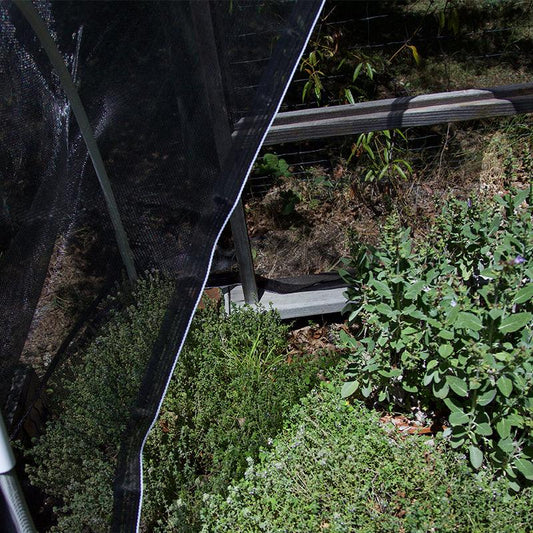
How shade cloth fits the water plan: Shade percentage describes how much incoming light the fabric is designed to block; it does not measure irrigation need or promise a temperature reduction. Choose a density only after comparing crop light requirements, measured exposure, root-zone moisture, airflow, canopy height, wind, and the structure's load capacity. Install cloth above foliage where practical, keep emitters and inspection paths accessible, and anchor it for the site. Recheck canopy recovery, leaf color, root-zone moisture, airflow, disease pressure, and fasteners after heat or wind. If the wetting pattern is inadequate, repair filtration, pressure, delivery, or zoning first: shade cloth cannot substitute for water reaching the roots, and too much shade can slow growth.
Choose equipment only after the failed function is known
When the audit identifies a delivery or zoning need, compare Irrigation & Watering. When measurement—not another input—is the gap, review Field Meters. If the diagnosed problem is radiant heat and the structure can be safe and ventilated, compare Sun Shade Cloths. Before ordering, confirm current availability, instructions, pressure compatibility, and destination eligibility; choose only an item that addresses the failed function.
Record the evidence for the fall reset
For each zone, log emitter output, wetting depth and width, runoff or ponding, crop recovery, shade hours and any test result. Repeat after repair under comparable conditions. A successful system is not the one with the longest runtime; it is the one that places appropriate moisture through the active root zone with less runoff, evaporation and inappropriate leaf wetness.
Add the reason for every manual override. “Heat forecast” is less useful than “pepper bed dry at root depth, west edge failed to recover overnight, two clogged emitters replaced.” Specific notes prevent an emergency adjustment from becoming an unexamined permanent schedule.
As summer crops finish, do not automatically carry their controller settings into fall. Re-zone for the new crop, shorter days, changing heat and local rain—if rain actually arrives. That condition-based reset protects water, soil structure and the next planting without pretending Southern California has one summer irrigation schedule.
Keep irrigation ready as seasons change
Use the fall irrigation guide to respond to the first rain, the winter water guide for rain gaps and drainage, and the spring irrigation guide to pressure-test the system before heat.
Gardens near a regional transition may also benefit from Bay Area drip-zoning guidance, Southwest pulse-irrigation and salinity guidance, or Sacramento–Sierra water-limit guidance. Apply only methods that match your soil, exposure, forecast, water source, and plants.