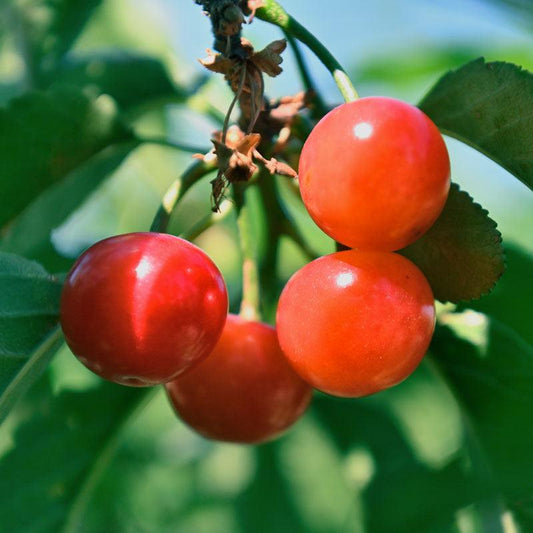
Self-fertile cherry trees can set fruit with their own pollen, but they still need pollen movement within flowers and may crop better with another compatible tree. This guide focuses on choosing a single-tree option and avoiding pollination mistakes.

Self-Fertile Does Not Mean Pollinator-Free
Bees and other insects move pollen within and among flowers. Cold, rain or wind during bloom can therefore reduce fruit set on a self-fertile tree. Avoid insecticides during open bloom unless the crop and use are allowed by the label and pollinator risk is addressed.
Sweet Versus Tart Cherries
Most widely grown tart or sour cherries are self-fertile. Many traditional sweet cherries require a compatible second cultivar, while several modern sweet cultivars are self-fertile. Pollination behavior is cultivar-specific; verify the exact named variety.
Examples of Self-Fertile Sweet Cherries
Stella, Lapins, Sweetheart, Craig’s Crimson and some other cultivars are commonly described as self-fertile. Availability and suitability vary, and a name on a general list is not enough: confirm chill requirement, hardiness, bloom timing, rootstock and disease fit for your site.

Would a Second Tree Still Help?
A compatible partner can increase pollen diversity and may improve set, but results depend on overlapping bloom, weather and bee activity. A second tree will not solve frost injury, shade, excessive nitrogen or damaged roots.
Multi-Grafted Cherry Trees
A multi-grafted tree can place several cultivars on one root system, potentially providing compatible pollen in a small space. Confirm that the grafts overlap in bloom and maintain balanced pruning so one cultivar does not dominate. A multi-graft is not automatically self-fertile if its components are incompatible.
Selection Checklist for One Tree
- Confirm the cultivar is self-fertile from a reliable current source.
- Match chill requirement and winter hardiness to the site.
- Choose a rootstock and mature size that fit the space.
- Check disease pressure and soil drainage.
- Compare harvest timing and intended use.
- Plan habitat and bloom-time practices that support pollinators.
If a Self-Fertile Tree Does Not Crop
Check tree age, bloom abundance, frost, bee weather, pruning, nitrogen, sunlight, water and pests. Use the cherry fruiting troubleshooting guide rather than assuming the label is wrong.
Compare Cherry Trees
Browse the cherry trees collection, then use the complete cherry growing guide for planting and care.