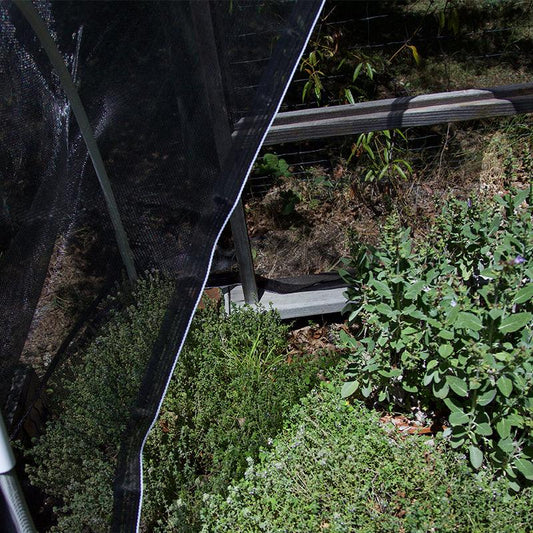
Protecting Southern California soil biology in summer starts with one decision: keep the root zone covered and reasonably stable without adding water or inputs the bed cannot use. Do not cultivate a hot, dry bed simply because a calendar says it is time to prepare for fall. First check moisture below the surface, soil structure, drainage, salt clues, crop condition, forecast heat and your ability to maintain whatever you plant. Then choose the least-disturbing response: maintain living roots, mulch, rest under residue, or make a test-informed amendment.
Use the Southern California summer plan to decide whether each bed should grow, rest, or recover. In growing and recovering beds, protect aggregation, infiltration, and biological activity without adding water or inputs the roots cannot use. Use the heat-adapted crop and bed-rest guide for crop choices and the drip, shade, and salinity guide when water movement or salt clues need diagnosis.
Diagnose the root zone before adding anything
A dry crust is not a complete diagnosis. Pull mulch aside and examine soil at more than one depth and location, including beside an emitter and at the expected edge of its wetting pattern. Record whether the soil is cool or warm, friable or smeared, evenly moist or sharply divided between wet and dry. Look for roots in the wetted volume, surface sealing, runoff paths, standing water, pale deposits, shrinking clay cracks and a sour odor. Compare those observations with plant recovery after the evening cool-down.
Wilting during an inland afternoon can be temporary heat response; wilting that persists overnight deserves investigation. Likewise, a coastal bed under a marine layer may remain moist longer than its surface suggests. The UC Master Gardener irrigation guidance emphasizes adjusting water to crop rooting depth, soil texture and weather rather than using a fixed frequency. That evidence matters before compost, fertilizer or extra water is prescribed.
| What you observe | Likely issue to test | Least-disturbing next move | What would change the answer |
|---|---|---|---|
| Surface dry; soil below remains cool and cohesive | Normal surface evaporation | Replace an appropriate cover and leave structure intact | Roots or crop fail to recover overnight |
| Emitter spot wet; surrounding root zone dry | Incomplete wetting pattern or root growth beyond the emitter | Inspect flow and placement; map moisture before changing runtime | Runoff, compacted layer or slope movement |
| Glossy smear, standing water or sour smell | Low oxygen and poor drainage | Pause traffic and inputs; let soil reach workable moisture | Persistent drainage failure requiring site correction |
| White crust or repeated marginal leaf burn | Possible salt accumulation, not a visual diagnosis by itself | Review water and fertilizer history; test soil or water | Laboratory result, crop sensitivity and drainage capacity |
| Bare, hot surface with weak structure | Exposure and aggregate breakdown risk | Apply compatible surface cover or plan maintainable living cover | Fire defensible-space rules, rodents or insufficient irrigation |
| Open bed with weeds setting seed | Rest period lacks a managed cover | Terminate seed-producing weeds; cover without aggressive tillage | A near-term fall planting window |
Use different soil strategies across Southern California
Immediate coast and marine layer: Cooler afternoons and longer leaf wetness can reduce evaporation, but sandy coastal soils may still drain rapidly. Check beneath mulch before irrigating. Keep mulch from holding moisture against crowns and avoid adding water merely because an inland forecast is hot. Where fog keeps foliage wet, favor root-zone delivery and airflow.
Coastal mesas: Wind exposure and compacted urban fill can create a dry-looking surface above a dense layer. Test infiltration in several places. A cover that stays put in wind and drip placement that actually spans the root zone may matter more than a deeper amendment layer.
Inland valleys: Hot surfaces, warm nights and high irrigation demand can accelerate moisture loss. Maintain cover, but do not mistake shade for adequate root-zone moisture. A bed that cannot be irrigated reliably is often better rested under residue than planted with a cover crop that will fail before establishing.
Foothills and canyons: Decomposed granite, slope runoff and Santa Ana wind exposure make erosion and fire planning part of soil care. Use short irrigation pulses only when observation shows runoff from a longer application, stabilize soil without creating continuous combustible mulch near structures, and follow current local defensible-space requirements.
Mountains and frost pockets: Summer can be hot, but the remaining frost-free runway may be short. Do not start a long-duration soil-building crop unless it can establish and be terminated before it conflicts with fall preparation or cold. USDA hardiness zones summarize average annual extreme minimum temperature; they do not predict a first frost or replace knowledge of a cold-air drainage pocket.
Sequence cover, roots, compost and rest
- Stabilize water delivery. Repair leaks and clogs, then verify the wetted volume. Adding mulch over a failed emitter hides the problem.
- Choose how the bed will be used. Keep a healthy crop, sow a maintainable cover, prepare for near-term fall planting, or rest beneath managed residue. Do not ask one bed to serve all four purposes at once.
- Retain useful roots. If a plant is healthy and not hosting a serious problem, cutting it at the soil line can preserve channels and reduce disturbance. Remove diseased material when sanitation guidance calls for it.
- Cover exposed soil. Use a material and depth suited to the crop, irrigation method, wind, pest pressure and fire setting. Keep organic mulch away from trunks, crowns and structures as required.
- Add mature compost only for a reason. Compost can support organic matter, but repeated additions may also add salts, phosphorus or other nutrients. Use history and a soil test instead of treating it as a universal summer tonic.
- Disturb narrowly. Open only the planting row or repair area that needs work. Avoid pulverizing dry soil or walking on wet clay.
- Recheck after an event. Heat, Santa Ana wind, smoke cleanup, a monsoon shower or an irrigation restriction can change the safest choice.
Use these guides to grow and terminate cover crops, make and assess compost, and respond to a soil test. Apply the techniques only when the bed’s temperature, moisture, water budget, next crop, and pest or fire constraints support them.
Do not work the soil when...
- It forms a slick ribbon, smears on the tool or compacts under a footprint.
- It is powder-dry and breaks into dust rather than stable crumbs.
- A heat advisory or dry wind makes exposed roots and workers vulnerable.
- Crop wilt has not been separated from emitter failure, root disease, salinity or pests.
- A slope is likely to shed soil during irrigation or a forecast storm.
- You intend to add fertilizer without a crop need, label-based rate and relevant test or site evidence.
- Weeds or residues may be carrying a pest or disease that requires a sanitation plan.
- The bed will remain bare afterward because cover and follow-up irrigation are not ready.
How the regenerative practices are supposed to work
Surface cover moderates exposure and can reduce evaporation. Living roots can maintain channels and supply root exudates while they remain healthy. Mature compost may contribute stable organic material. Reduced disturbance protects existing pores and fungal networks. None guarantees a result: a cover crop that consumes scarce irrigation, a thick mulch that shelters rodents, or repeated compost that raises salts can work against the objective.
Treat better aggregation, infiltration and organic-matter retention as outcomes to monitor. Photograph the same patch, repeat a simple infiltration observation under similar moisture conditions, note rooting depth and track laboratory results over time. One dramatic input application is less informative than a record showing whether the bed accepts water more evenly and supports crops with fewer corrective inputs.
Watch pests, heat and weather without overcorrecting
Spider mites and whiteflies often become conspicuous during hot, stressful periods, while aphids and honeydew-tending ants can complicate new growth. Inspect leaf undersides and use the UC IPM identification and management resources before choosing a treatment. Soil moisture problems and salt injury can resemble biological damage, so correct delivery failures first. If a pesticide is justified, the product must be labeled for the site and target, registered for use in California where required, and applied exactly as directed.
After smoke or ash, avoid aggressive leaf washing when water is restricted or the material is unknown; follow local public-health guidance. After intense rain or hail, wait until soil is workable and restore cover where runoff exposed it. Rain is not guaranteed, so a fall reset must work even if irrigation remains the only dependable source.
Choose materials only after the diagnosis
Once the table and no-work checklist identify a real need, compare Soil Amendments, Year Round Cover Crop Mixes, or Soil Testing. Before choosing a specific item, confirm its current availability, label or directions, shipping eligibility, and fit for the bed. A test may show that the best purchase is no amendment at all.
Make fall the measured reset
As nights moderate and a bed’s summer use ends, compare root-zone moisture, drainage, salt evidence, residue condition, and the next crop’s needs. Preserve useful cover until the next planting is ready. In a coastal garden, the reset may focus on drainage and disease-aware airflow; inland it may focus on restoring an even wetting pattern; on a slope it may focus on erosion protection; in a mountain pocket it must also account for the shortening frost runway.
The practical standard is simple: protect soil from avoidable exposure, keep disturbance proportional to the problem, and make every input answer an observed need. This prepares the bed for its next use without forcing one summer soil schedule across Southern California.
Keep a short bed log with the observation depth, irrigation event, weather, crop response and action taken. Repeating the same checks after a week or a major weather event helps distinguish a durable improvement from a temporary surface change and gives the fall gardener a useful baseline.
Protect soil through the changing seasons
Use the fall soil guide to repair summer stress, the winter soil guide to avoid working or watering saturated beds, and the spring soil guide to prepare for the next hot season.
If your garden lies near a regional boundary, compare Bay Area summer soil guidance, Southwest extreme-heat soil guidance, or Sacramento–Sierra living-soil guidance. Use only practices that fit your soil, exposure, forecast, water, and crops.