Zone Sacramento-Sierra drip irrigation by soil, crop, slope and exposure, then verify pressure and wetting before changing runtime. Heavy Sacramento Valley clay may need slower delivery or separated pulses, while foothill slopes need high-to-low pressure and runoff checks. Delta wind and young perennials create different demand again. A controller setting is never a substitute for observing the root zone.
Start by matching your irrigation decisions to the site: Sacramento Valley floor, Delta-influenced garden, lower Sierra foothill or higher-elevation frost and snow zone. Valley gardens often need extreme-heat and heavy-clay adjustments, while Delta sites can be cooler and windier with different irrigation demand.
Use this water audit with the regional summer resilience plan. The soil guide helps you choose cover without hiding delivery problems; the crop guide helps you decide whether a planting has enough runway to justify continued watering.
Follow the irrigation and drainage decision tree
- Is outdoor work appropriate? If heat, smoke, fire or access guidance says no, postpone nonessential checks and follow authorities.
- Is the crop stressed? If no, inspect on schedule. If yes, compare overnight recovery and root-zone moisture.
- Is active-root depth dry? If no, investigate heat, roots, salts, pests or saturation instead of automatically watering.
- Is delivery reaching every position? Compare the first/farthest emitter and high/low slope points; repair leaks, filters and pressure faults.
- Does water enter the root volume? If it ponds or runs off, reduce application intensity, reposition emitters or test divided pulses.
- Is wetting uniform enough for the crop? If it is narrow or patchy, correct layout before increasing total water.
- Has weather or the crop changed? Adjust from measured moisture and plant stage, not the prior program alone.
- Can the result be documented? Record run time, output or wetting, starting moisture, runoff and next inspection trigger.
Observation checklist
- Filter, regulator, valves and mainline show no visible fault.
- Beginning and end of each lateral operate.
- High and low slope positions receive comparable intended delivery.
- Emitters are visible enough to inspect and are not buried against trunks.
- Wetting reaches active roots without flooding paths or structures.
- Valley clay absorbs application without ponding or surface flow.
- Foothill soil does not channel around rocks or move downslope.
- Container, annual and perennial zones have separate decisions.
- Mulch is pulled back for inspection and replaced with correct clearance.
- Controller programs reflect current crop, weather and restrictions.
Compare four irrigation tracks
| Segment | Typical problem | Test | Adjustment gate |
|---|---|---|---|
| Valley floor | Heavy clay ponds while deeper soil remains uneven | Observe infiltration during and after a measured cycle | Use slower delivery or pulses only when observation shows benefit |
| Delta-influenced | Wind dries exposed beds and moves spray or mulch | Compare exposed and sheltered root zones | Change zoning or protection from measured difference |
| Lower foothill | Pressure and runoff vary down a slope | Compare high, middle and low outputs and wetting | Correct pressure/layout before adding duration |
| Higher foothill | Demand falls as nights cool while systems remain on summer settings | Track root moisture and crop/perennial stage | Reduce or winterize from conditions and local freeze risk |
Audit source to root
Start upstream. Confirm the available source and any current restrictions, then inspect backflow protection, filtration and pressure regulation as appropriate to the system. Follow equipment instructions and local requirements. A clogged filter may reduce an entire zone; a split lateral may make one bed look inexplicably dry.
At emitters, measure or compare actual output when practical. Identical labels do not guarantee identical field delivery after elevation change, clogging, wear or mixed components. Replace or service parts according to specifications. Do not enlarge holes or improvise a repair that defeats pressure regulation.
Once the audit identifies where delivery is failing, use the established guides for irrigation maintenance and drip-irrigation technique.
Test the soil response
Run one representative zone for a measured interval and observe during application. Note when ponding or runoff begins. After water has redistributed, inspect the wetting pattern at relevant depth and distance from emitters without damaging major roots. Repeat at the far end and at high and low points.
In clay, a separated cycle may allow infiltration between applications. On coarse or rocky foothill soil, pulses may behave differently and overly small applications may wet only a shallow volume. The correct pattern is the one that supplies the crop's active roots while limiting runoff and deep loss.
Build real hydrozones
Separate crops with meaningfully different roots, stages and exposure. Young trees need a developing root-zone pattern; established trees often occupy a broader volume. Containers respond quickly and cannot be inferred from an in-ground bed. A sunny lower slope should not be forced to share a decision with a shaded canyon bench simply because tubing reaches both.
Move a bed to another zone when its crop changes. Cap unused outlets and record the change. If one controller station contains incompatible plants, redesign may save more water than repeated schedule compromises.
Respond to heat, wind, smoke and outages
Before forecast extreme heat, verify delivery early enough to repair faults. Do not saturate a bed as a generic protective measure. During wind, inspect moved tubing, anchors and exposed roots. After smoke or an outage, follow official safety and utility information and recheck programs that may have reset.
A power interruption can affect wells, pumps and timers. Plan around the actual backup capacity rather than assuming uninterrupted irrigation. Never enter unsafe areas to service a garden system during an emergency.
Keep mulch and shade connected to the water audit
Mulch can reduce surface evaporation, but it can also hide leaks, rodents or saturated crowns. Pull it aside at inspection points and keep it off trunks. Shade can reduce load for selected crops yet changes airflow and distribution; secure it for wind and continue to measure soil.
Neither tool fixes poor pressure. If the far emitter is dry and the near emitter floods, correct hydraulics first.
Two local examples
Valley clay: Water ponds ten minutes into a cycle, while a probe later shows only a narrow wetted zone. The gardener corrects emitter spacing and tests divided application. Runtime is changed only after wetting improves.
Foothill slope: Lower emitters discharge more and runoff reaches a path. The gardener verifies regulator and lateral design, uses pressure-compensating components where appropriate and separates the slope from the flat perennial zone.
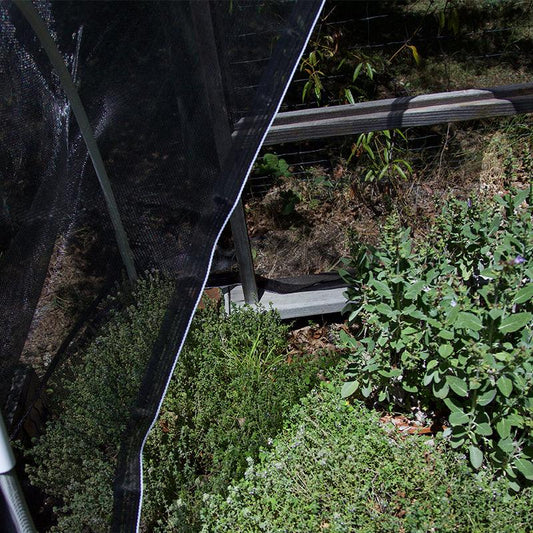
How shade cloth fits the water plan: Shade percentage describes how much incoming light the fabric is designed to block; it does not measure irrigation need or promise a temperature reduction. Choose a density only after comparing crop light requirements, measured exposure, root-zone moisture, airflow, canopy height, wind, and the structure's load capacity. Install cloth above foliage where practical, keep emitters and inspection paths accessible, and anchor it for the site. Recheck canopy recovery, leaf color, root-zone moisture, airflow, disease pressure, and fasteners after heat or wind. If the wetting pattern is inadequate, repair filtration, pressure, delivery, or zoning first: shade cloth cannot substitute for water reaching the roots, and too much shade can slow growth.
Choose equipment after the audit
For source-to-root repairs, compare Irrigation & Watering. For zone layout and emitters, review Drip Irrigation. If a measurement tool answers the identified question, compare Field Meters. Confirm compatibility, live availability and instructions before purchase.
Record a defensible summer baseline
Read distribution failures by pattern
| Pattern | Likely place to inspect | Correction principle | Confirmation |
|---|---|---|---|
| Entire zone weak | Source, valve, filter, regulator or supply | Restore upstream function to specifications | Compare output after repair |
| End of lateral weak | Length, pressure, clogging or leak | Correct design/fault instead of lengthening runtime | Beginning/end wetting check |
| Lower slope flooded | Elevation and pressure variation | Rezone or use suitable pressure compensation | High/middle/low comparison |
| One plant dry | Emitter placement, clog or root mismatch | Repair that delivery point and root coverage | Inspect wetting around active roots |
| Whole bed wet but crop wilts | Drainage, roots, disease, heat or salts | Diagnose rather than add water | Root and plant examination |
| Runoff before depth is wet | Application intensity, crust or slope flow | Lower intensity, reposition or test pulses | No runoff and useful wetting depth |
Use measurements with appropriate limits
A catch-can or measured-emitter test can compare delivery, but use a method suited to drip hardware and follow equipment guidance. A hand probe shows current moisture at a point, not the whole root system. Electronic meters vary by design, calibration, salinity and soil contact; understand what a device actually measures.
Mark sample points and use the same method. Include an outlier location—the far end, high point or hottest edge—rather than testing only near the valve. Compare results after repair under similar starting conditions. More precision in a number does not compensate for sampling the wrong zone.
Repeat the inspection after mulch is moved, roots expand or a bed changes crop. Hardware can stay identical while the useful wetting volume changes.
After any controller adjustment, place a recheck on the calendar for the condition—not merely the time elapsed. A weather shift may require inspection sooner, while stable soil may justify waiting.
Remove temporary controller overrides after their documented trigger passes safely.
Consider water quality without inventing a diagnosis
Recurring crusts, clogged emitters or marginal burn can justify reviewing irrigation-water and soil history. These symptoms have multiple causes. Obtain appropriate laboratory guidance before interpreting salinity, pH or specific ions, and match any response to crop sensitivity, soil drainage and local discharge constraints.
Flushing or leaching is not a universal solution and can waste water, move nutrients or worsen drainage. Do not recommend it without verified need, adequate drainage and a legal, site-appropriate plan. Fertilizer injection likewise requires system compatibility, backflow protection, a soil- and crop-grounded purpose and exact label compliance.
Plan maintenance around service life
Protect tubing from abrasion, tools, rodents and excessive tension. Replace damaged sections, but keep compatible reusable fittings where sound. Store spare parts by size and system so emergency repairs do not introduce mismatched components. At season transition, flush or winterize only according to the equipment and local freeze risk.
Map underground or hidden lines before cultivation. A repair that prevents leaks and extends system life supports resilience, but plastic components still have manufacturing and disposal impacts. Track what fails so future designs use fewer incompatible pieces.
For every zone, log soil and crop, exposure, slope position, emitter type, measured output or wetting, run interval, weather, runoff and crop recovery. Map repairs and date filter service. Recheck after a crop change, extreme event or restriction.
The intended outcomes—less runoff and evaporation and more uniform root-zone moisture—are not guaranteed by drip equipment. They must be demonstrated in the soil. A summer irrigation setup is working when each active zone has verified delivery and a clear condition that will trigger the next adjustment.
Plan for the next season
As crop demand, weather and freeze risk change, use the fall guidance, winter guidance, and spring guidance.
If your water demand resembles a neighboring climate more closely, compare the Bay-Area guidance, SoCal guidance, and Rockies guidance. Adjust any borrowed practice to your soil, exposure, forecast, water source and measured root-zone response.