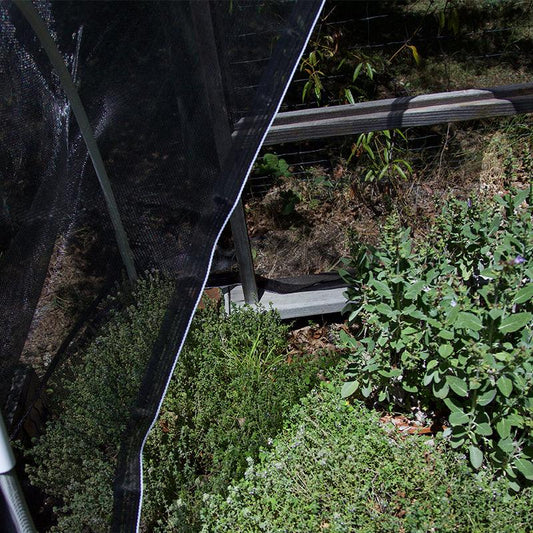
Protect Sacramento-Sierra summer soil by diagnosing heat, moisture, structure, cover and fire-compatible placement before adding mulch or amendments. In heavy Valley clay, the need may be surface shade without more cultivation; on a foothill slope, it may be anchored cover that does not block runoff or conflict with current defensible-space rules. Keep mulch off trunks and crowns, and use inputs only for a measured purpose.
Use the regional summer resilience plan to coordinate soil care with the whole garden. For crop choices, see the crop guide; for distribution and pressure checks, use the irrigation guide.
Use the soil-condition decision table
| Observation | Likely condition | Least-disturbing next action | Do not... |
|---|---|---|---|
| Hot, bare surface; root depth adequately moist | Excess exposure | Add compatible cover with trunk and fire clearance | Increase water from surface appearance alone |
| Dry at root depth under intact mulch | Delivery or demand problem | Check emitters, pressure and wetting before changing runtime | Assume mulch replaces irrigation |
| Valley clay ponds or cracks | Application/structure mismatch | Test slower or pulsed delivery and preserve fixed paths | Till dry clods or wet clay during heat |
| Foothill water moves downslope | Runoff or preferential flow | Repair layout, protect contour and inspect high/low pressure | Bury the symptom under imported material |
| Mulch against trunk or crown | Moisture, pest or bark risk | Pull material back and inspect bark | Build a mulch volcano |
| Pale crust or marginal burn recurs | Possible salts or input accumulation | Review water and amendment history; test | Add compost or fertilizer automatically |
| Open bed with no establishment water | Cover-crop constraint | Retain safe residue or use another low-water cover strategy | Sow a living cover with no survival plan |
Read four local soil tracks
Sacramento Valley floor: Heavy clay can accept water slowly yet crack dramatically at the surface. Probe below the cracks. Preserve permanent paths, apply water at a rate the bed can absorb and avoid pulverizing the surface during heat.
Delta-influenced gardens: Wind can dry and displace lightweight material even when air is cooler. Anchor residue without sealing the surface, check the leeward and windward edges and verify moisture at depth.
Lower foothills: Rocky or decomposed-granite soils may drain rapidly while red or finer pockets hold water differently. Manage each zone, keep cover aligned with safe contour protection and observe whether application becomes runoff.
Higher foothills: The summer window may already be shortening. Soil cover should support fall readiness, not create a residue problem that cannot be terminated before cold soil or snow.
Do not work the soil when...
- Heat and wind would leave newly exposed aggregates unprotected.
- Valley clay smears when moist or breaks into hard clods when excessively dry.
- Traffic would compact the only moist root zone.
- A slope is unstable or a storm could carry loosened material.
- The intervention has no defined next crop, repair or sampling purpose.
- Roots are actively maintaining cover and do not obstruct the next operation.
- A suspected salt or nutrient issue has not been tested.
- Smoke, heat or fire guidance makes nonessential work inappropriate.
Sequence mulch and living-soil work
- Map the crop root zone, trunk and crown clearances, structures and emergency-access edges.
- Probe moisture and temperature beneath current cover and in an exposed comparison point.
- Repair irrigation distribution and runoff before adding material.
- Remove only confirmed diseased, infested or unsafe residue.
- Retain roots or residue where the next crop and sanitation allow.
- Select mulch or cover by water, termination, pest, wind and defensible-space constraints.
- Add mature compost only when soil test, crop need and input history justify it.
- Recheck moisture, pests, movement and bark contact after irrigation or wind.
Choose cover by function and exit plan
Living roots can support soil organisms and maintain aggregation, but a living cover uses water. During peak Valley heat or limited supply, retained crop roots, surface residue or a deliberately rested mulched bed may meet the soil objective with less establishment demand. A cover crop belongs only where seed, season, irrigation and termination all fit.
On foothill slopes, avoid a bare interval between termination and fall weather. Stagger work or retain residue so soil remains protected. Keep vegetation and organic material placed according to current local fire and defensible-space requirements; no mulch is universally appropriate in every zone.
Once you have identified the site constraint, use the established guides for cover-crop technique, compost management and soil-test response.
Keep mulch away from trunks and hidden failures
Spread compatible material over the active root-zone surface while maintaining visible clearance around woody trunks, canes and crowns. Do not pile material against bark. Inspect before replenishing: moisture trapped at the crown, rodent activity, buried emitters and damaged ties can disappear under repeated layers.
Mulch does not prove adequate watering. Probe beneath it at representative depths. If one emitter creates a narrow wet column while most roots remain dry, correct layout or delivery. If heavy clay stays saturated, adding more cover without reducing or redistributing water can prolong the problem.
Use amendments from evidence, not summer stress alone
Heat-stressed leaves do not diagnose a fertilizer shortage. Roots in dry, saturated, hot or saline soil may be unable to function normally. First correct water movement and identify pest or weather injury. Then use a properly collected soil test, crop needs, previous inputs and the product label to decide whether an amendment is justified.
Repeated compost can add phosphorus, salts or other nutrients. Source quality and maturity matter. Run a reference strip for a substantial change and record material, amount, water use and crop response. Darker soil is not by itself evidence of better function.
Respond to summer events
After extreme heat: Compare covered and exposed root zones and check overnight plant recovery before changing the system. Postpone cultivation and major root disturbance.
After Delta wind: replace displaced material, inspect abrasion and secure covers without blocking airflow.
After a foothill storm: inspect rills, concentrated flow and downslope deposits before repairing the surface. Serious drainage or slope instability needs qualified assessment.
During smoke or fire operations: follow authorities. Avoid running combustion equipment or performing dusty, nonessential work when conditions or rules make it unsafe.
Two Sacramento-Sierra examples
Valley clay: A pepper bed looks dry at noon, but the probe shows adequate moisture below a hot crust. Plants recover overnight. The gardener maintains mulch clearance, checks emitters and does not add water or fertilizer from appearance alone.
Lower-foothill contour cover: A harvested row lies above a driveway and irrigation runs to the lower edge. The gardener corrects pressure and application, retains compatible residue across the contour and delays new living cover until establishment water and termination are secured.
Choose materials after diagnosis
If the decision calls for an input, compare Soil Amendments. For a bed with a water and termination plan, review Year Round Cover Crop Mixes. If the constraint is uncertain, begin with Soil Testing. Confirm live availability, instructions and site fit before purchase.
Measure the regenerative outcome
Compare cover materials by the problem they solve
Retained crop residue is often the lowest-import option when it is free of a confirmed sanitation problem and will not obstruct the next operation. Chopped or intact placement changes wind movement and decomposition. On Delta edges, test whether it stays in place; on a slope, make sure it does not collect into a dam.
Imported organic mulch can shade soil, but source, particle size, transport, weeds or contaminants, decomposition and future handling matter. Apply enough to serve the measured function without burying crowns, emitters or inspection points. Repeated additions should not quietly raise the grade against trunks or structures.
Living cover offers active roots and potentially more diverse biology, but only when seed is suited to the window and establishment and termination are funded. A mix marketed for year-round use still needs species-level review for water, heat, future crop and local restrictions. Do not claim a cover is native without an authoritative geographic source.
Reusable fabric or shade can reduce surface exposure in a defined situation, yet it brings anchoring, ventilation, plastic wear and end-of-life questions. It should not seal soil, shed runoff toward structures or remain forgotten after its purpose ends.
Use a repeatable soil observation protocol
- Mark one exposed point and one covered point in the same management zone.
- Record crop, soil, slope, recent irrigation and weather before observing.
- Measure temperature at the same depth and general time on comparable days.
- Probe moisture at active-root depth, not only in the upper mulch layer.
- Observe infiltration from a defined application without working wet soil.
- Photograph surface cover, cracks, rills and plant recovery from fixed positions.
- Repeat after heat, wind, a storm or a material change.
A difference between covered and exposed points can support a local decision, but it is not a replicated experiment and does not prove a universal effect. Shade, emitter position, roots and starting moisture may differ. Record those limitations.
Protect the soil-perennial boundary
Young trees and berries are where soil cover, irrigation and bark health meet. Keep the trunk flare and crowns visible, move emitters outward as roots expand and inspect guards and ties. Damp bark, rodent shelter or a hidden leak can offset the benefit of cooler soil.
On mature trees, do not assume canopy shade means the whole active root zone is moist. Sample several directions. Avoid cultivating through major roots to incorporate an amendment. Surface application, if supported by testing and the label, may be the less disruptive option.
Record percentage of covered soil, root-zone moisture trend, runoff, visible aggregation, infiltration at comparable starting moisture, pest signs and imported inputs. The intended outcomes—better aggregation, less erosion or compaction, organic-matter retention and fewer unnecessary inputs—are mechanisms to test, not guarantees.
Set the next trigger: a harvest opening, irrigation repair, cooler soil, effective rain or enough fall runway for a chosen cover. The bed is ready for its next transition when the soil is protected and the change can be made without undoing its structure.
Plan for the next season
When soil temperature, rainfall or bed readiness changes, use the fall guidance, winter guidance, and spring guidance.
If wind, fog or elevation makes your soil behave more like a neighboring climate, compare the Bay-Area guidance, SoCal guidance, and Rockies guidance. Keep only the practices that fit your soil, exposure, forecast, water supply and observed crop response.