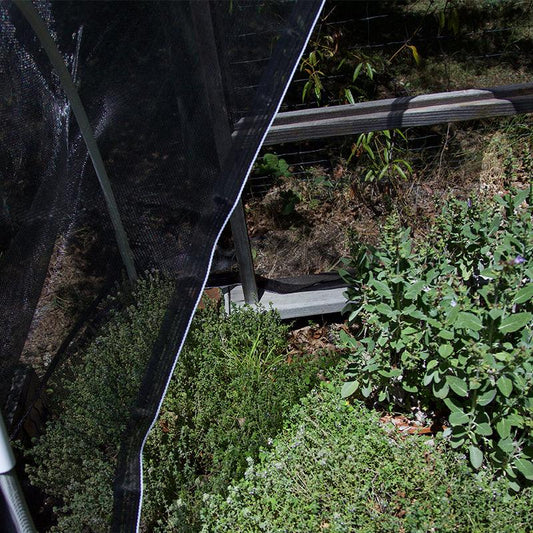
A water-wise Bay Area summer plan starts by identifying which summer the garden is actually experiencing. Near the coast, fog, wind, cool soil, and longer leaf wetness can limit heat-loving crops even while irrigation remains necessary. A few miles inland, dry afternoons and hot nights can raise crop demand quickly. Bayside clay stores water differently from sandy coastal soil, and an exposed hill loses moisture differently from a sheltered frost pocket. There is no useful region-wide watering or planting calendar.
Use the same practical order even when recommendations change: measure root-zone moisture and overnight crop recovery; protect soil; divide irrigation by plant and soil need; keep crops that fit available heat and water; scout before treating; and begin fall preparation while summer crops are still active. Coordinate soil, crop, irrigation, IPM, and turnover decisions around those observations.
Diagnose the summer you have
Begin with a garden walk at two times: near the end of the warmest part of the day and again the following morning. Temporary afternoon flagging can be a normal response, while plants that fail to recover overnight may have an irrigation, root, heat, disease, or salinity problem. Probe moisture at active root depth rather than judging only the surface. Check several locations, including the beginning and end of a drip line, the uphill and downhill sides of a slope, containers, and the edges of beds.
Then compare the garden with the forecast and with its recent pattern. A heat advisory, a smoky period, unusual coastal clearing, persistent fog, strong wind, or an irrigation restriction can change priorities quickly. Record which plants are flowering or fruiting, which beds are finishing, and how many condition-appropriate growing days remain before the next local limit. In a fog-coast garden that limit may be insufficient heat; inland it may be water stress or a future frost window for a late succession.
Regional condition checklist
- Does the root zone feel dry, adequately moist, or saturated at the depth where most active roots are located?
- Do wilted plants recover overnight, or is stress persistent?
- Are emitters flowing evenly, and is water infiltrating rather than running off or bypassing a root ball?
- Is the soil shaded by living foliage, residue, or an appropriate surface cover?
- Is fog or irrigation keeping leaves wet long enough to raise disease concern?
- Are warm-season crops setting and ripening, or holding green growth without useful progress?
- Are pests active now, or are old symptoms being confused with current damage?
- Are open beds ready for a short cover, protected rest, or fall crop establishment?
- Do smoke, wind, fire-weather restrictions, water rules, or a local heat advisory change today’s safe work?
Do not assume that a cool morning or fog layer has replenished the root zone. Fog can reduce evaporative demand, but it does not replace measured irrigation unless water has actually entered the soil. Likewise, a hot surface does not prove the root zone is dry. The probe and the plant together are more useful than either clue alone.
Compare the four Bay Area summer segments
| Segment | Controlling summer conditions | Primary garden decision | Common mistake |
|---|---|---|---|
| Coastal fog belt and marine terraces | Cooler air and soil, wind, variable sun, longer leaf wetness, sandy or shallow soils in some sites | Favor crops and successions that can finish with available heat; irrigate from root-zone evidence; preserve airflow | Growing inland heat lovers by calendar, or assuming fog means no irrigation is needed |
| Bayside flats and heavy soils | Clay or clay loam, urban heat effects, slow infiltration or drainage, large differences between raised and in-ground beds | Apply water slowly enough to infiltrate, protect structure, and separate surface dryness from deeper moisture | Short, frequent watering that wets only the surface, or adding water to already wet subsoil |
| Warmer inland valleys | Higher heat accumulation, dry afternoons, rapid crop development, warm containers, occasional heat waves | Prioritize dependable hydrozones, root-zone cover, heat-fit crops, and early fall propagation in a protected place | Waiting for visible collapse before checking irrigation, or planting a succession that cannot finish before the next local constraint |
| Exposed hills and frost pockets | Wind and runoff on slopes; cooler nights and eventual frost risk in low areas; highly variable solar exposure | Use cycle-and-soak where needed, secure shade and supports, and count crop maturity from the actual site | Treating the property as one irrigation zone or using a broad USDA zone as a planting calendar |
USDA hardiness zones summarize average annual extreme minimum temperatures; they do not describe a summer’s heat, fog, wind, or first frost date. Treat a zone label as one screening tool, not permission to ignore local temperature and crop development.
Sequence the whole-garden work
1. Set a water budget from evidence
List the garden’s active hydrozones: containers, shallow-rooted annual beds, newly established berries or trees, mature perennials, and any resting or cover-cropped beds. Their root volume and exposure differ. Probe each representative zone and check emitter delivery. If a plant is stressed while the surrounding soil is wet, look for root injury, a dry root ball, compaction, disease, or salinity before increasing the schedule.
Prioritize high-value or vulnerable plants within the available water budget. A bed that cannot be supported through the expected conditions may be better harvested and protected with residue or mulch than kept barely alive. That is a resource decision, not a gardening failure. The detailed Bay Area summer drip-zoning plan explains emitter, timing, slope, and evaporation decisions.
2. Keep soil covered without hiding problems
Living roots can feed soil organisms and protect aggregation where temperature and water permit. Crop residue or an appropriate surface mulch can reduce bare-soil heating and raindrop impact, and may reduce avoidable evaporation. But dense cover against crowns can retain excess moisture or shelter slugs, snails, earwigs, and rodents. Keep trunks and sensitive crowns clear, inspect under cover, and follow current local defensible-space rules on fire-prone properties.
Do not cultivate clay when it is saturated, and do not repeatedly disturb dry soil simply to make the surface look finished. Use the guide to keeping Bay Area soil alive through the dry season to decide when cover, residue, mulch, or waiting will protect the bed.
3. Decide which crops earn summer space
Evaluate crops by current health, remaining productive potential, days to maturity, heat accumulation, night temperature, and water requirement. On the fog coast, lettuce and other cool-tolerant successions may remain viable where a tomato fails to ripen well; crop choice still depends on cultivar, light, wind, and disease pressure. Inland, warm-season crops may thrive with adequate water and heat protection, while a poorly timed cool crop bolts or stalls.
Remove plants that are declining beyond a useful threshold, especially when they are serving as pest or disease reservoirs. Leave soil protected afterward. If fall crops need a long lead time, start a small backup sowing under conditions that support germination and hardening rather than crowding it into an overheated bed. Use the two-summers crop and succession matrix to match the next crop to heat, light, water, and remaining time.
4. Scout before summer stress disguises the cause
Mites can produce stippling and bronzing in hot, dusty conditions; whiteflies and aphids occupy leaf undersides and tender tissue; rodents may remove fruit or shoots; foliar disease becomes more likely where leaf wetness persists. Heat, wind, irrigation failure, root saturation, salinity, and smoke can also discolor or wilt plants. Inspect the organism, damage pattern, root zone, and recent weather before choosing a control.
Support functional beneficial habitat without turning every dense patch into permanent shelter beside vulnerable seedlings. Use thresholds, physical or cultural measures, and only then a correctly labeled targeted material where needed. The Bay Area summer pest-versus-stress guide can help separate pest damage from heat, water, wind, and root problems.
5. Begin fall preparation early
Fall planning begins when a summer crop’s likely finish overlaps an autumn crop’s propagation and establishment needs—not on a universal calendar date. Inventory open beds, seed, propagation space, irrigation capacity, and compost or test results. Decide where a short cover crop can mature or be terminated appropriately, where a bed should rest under cover, and where transplants need to be started before the main bed opens.
Selective shade can help propagation or reduce acute heat load, but it must be ventilated and secured against wind. Remove it when light or temperature no longer calls for it. Use the shade, harvest-turnover, and fall-start checklist to coordinate crop removal, soil cover, supports, irrigation, and fall starts.
Use a condition-based action timeline
| Trigger | Act now | Recheck before the next step |
|---|---|---|
| Plants recover overnight; root zone is adequate | Maintain the current zone, repair small distribution problems, keep soil protected, and continue monitoring | Probe after a representative irrigation and again as weather changes |
| Plants do not recover overnight; root zone is dry | Confirm emitter function, apply enough water to wet the active root zone without runoff, and reduce avoidable heat or wind exposure | Check infiltration and recovery; do not automatically repeat the application |
| Plants are stressed but soil is wet | Pause automatic watering and investigate drainage, compaction, root disease, a dry root ball surrounded by wet soil, or another non-drought cause | Resume only when root-zone evidence supports it |
| Heat advisory or unusual coastal clearing is forecast | Inspect water delivery before the event, harvest vulnerable produce, secure supports, and use condition-appropriate temporary shade | Vent structures, watch night recovery, and remove protection when it becomes a light or airflow liability |
| Persistent fog or humidity extends leaf wetness | Improve airflow, keep irrigation off foliage where practical, scout susceptible plants, and thin only as appropriate for the crop | Distinguish active disease from old spotting before treatment |
| A summer crop finishes or declines | Harvest, remove consequential diseased material, retain safe soil cover, and choose a fall crop, short cover, or protected rest | Compare the next crop’s maturity and establishment needs with local heat and frost trajectory |
| Smoke, wind, or fire-weather restrictions affect the site | Follow public-health and local safety guidance, postpone strenuous or aerosol-producing work, secure loose material, and protect irrigation function | Inspect plants and systems after conditions improve; do not assume visible injury has one cause |
| First meaningful rain becomes plausible later in the transition | Clear blocked drainage paths, protect bare soil, and rebuild infiltration without disturbing saturated clay | Check actual root-zone moisture; one rain does not necessarily end irrigation demand |
This timeline is intentionally responsive. Watering frequency depends on soil, weather, crop stage, root volume, irrigation delivery, and restrictions. Fertility depends on crop need, soil or tissue evidence where appropriate, and the product label. Pest and disease responses depend on identification and threshold. A fixed weekly instruction would erase the conditions that make Bay Area summers different.
Connect regenerative practices to measurable outcomes
Soil cover can moderate surface temperature and reduce direct evaporative loss; living roots can support soil biology and aggregation when the water budget permits; hydrozoning can reduce watering that misses the intended root system; and flower or refuge habitat can support beneficial organisms. These are mechanisms, not guarantees. Measure them through infiltration, moisture distribution, soil-cover continuity, crop recovery, pest trends, and the amount of replacement material required.
Tradeoffs matter. A living cover that consumes scarce water or competes with a young perennial may not fit the current site. Imported mulch has transport and application costs and may conflict with fire-safety rules. Shade cloth can reduce acute load but also lower photosynthesis, trap heat when poorly ventilated, and create plastic waste. Beneficial habitat can shelter pests. Selective use, maintenance, reuse, and end-of-life planning are part of the water-wise decision.
Test before feeding. A pale plant in wet clay or with damaged roots may not respond to fertilizer, and excess nitrogen can create tender growth attractive to some pests. Use representative soil results, crop requirements, and label directions. Nutrient cycling is more resilient when additions solve a documented limitation rather than follow a seasonal habit.
Respond safely to heat, smoke, wind, and unusual storms
Before extreme heat, confirm irrigation delivery while conditions are still safe to work, harvest tender produce, and secure shade. Avoid pruning that suddenly exposes trunks or fruit to strong sun unless disease or breakage makes removal necessary. Temporary trunk or crop protection must be installed and ventilated safely. No shade or watering tactic guarantees protection, especially during extended heat.
During smoke events, follow current public-health guidance and limit outdoor exertion when air quality is poor. Do not make food-safety claims from appearance alone; use current institutional guidance for washing and harvest decisions. Ash and smoke injury can overlap with heat and water symptoms, so document timing before treating a presumed pest or deficiency.
Strong wind increases plant water loss, damages leaves, and can turn loose cloth or supports into hazards. Secure structures for expected loads and remove unsafe material. On hills, protect soil while keeping drainage paths open. Although Bay Area summer is normally dry, localized storms can produce runoff on compacted or bare ground. Preserve infiltration and avoid sending water, sediment, or amendments off site.
Build a simple water-budget worksheet
For each hydrozone, write down the crop or perennial, approximate rooting area, soil or container type, exposure, emitter type and measured output, current growth stage, and moisture observation before irrigation. After a representative run, record how deeply and evenly water moved and whether runoff occurred. The numbers do not create a universal schedule; they reveal whether the system is delivering what its runtime implies. Repeat the check when plants enlarge, containers become root-bound, filters clog, emitters move, or weather shifts.
Include a “stop or reduce” trigger as well as an “add water” trigger. Saturated soil, poor overnight recovery despite wet roots, algae or persistent surface wetness, drainage from a container long after irrigation, and water moving past the intended root zone all call for diagnosis before another automatic cycle. On heavy soil or slopes, splitting an application may improve infiltration, but verify the result rather than assuming cycle-and-soak always solves the problem. On sandy soil and in containers, smaller root volumes can dry differently; probe the actual zone.
Finally, rank zones by consequence. Newly established woody plants, actively producing annual beds, mature drought-adapted perennials, and fall propagation do not share the same vulnerability or recovery cost. Local water restrictions and plant suitability still control the decision. If available water cannot sustain every zone, harvest or rest the lowest-priority bed, protect its soil, and concentrate on systems that can be carried through the expected conditions. That transparent choice is more water-wise than spreading insufficient irrigation across the entire garden.
Choose products only after defining the need
Once the water budget and hydrozones are mapped, compare the verified Irrigation & Watering collection by pressure, flow, filtration, crop, soil, slope, and system compatibility. If diagnosis supports a treatment rather than a water or weather correction, review Organic Pest Control against the identified organism and current label; do not begin with a broad-spectrum product.
Where an open bed has enough water and time for the selected species, compare Year Round Cover Crop Mixes by establishment needs, termination plan, maturity, and local restrictions. For a documented heat or propagation need, use Sun Shade Cloths to compare shade percentage, dimensions, airflow, anchoring, reuse, and crop response. Choose a specific item only when its verified characteristics fit the measured need. Recheck Online Store availability and regional eligibility immediately before purchase.
Coordinate soil, crops, water, pests, and turnover
Use the summer gardening tips for general seasonal tasks. Keep related decisions connected: changing soil cover affects irrigation and pest habitat; removing a crop changes emitter placement and fall timing; adding shade changes light, airflow, and moisture. Recheck the garden after each major change rather than treating any one system in isolation.
Compare the Bay Area spring plan with the Bay Area fall plan so beds remain protected during the transition. A bed can stay cropped, move into an appropriate cover, retain clean residue, or rest beneath protective surface cover according to water, pest, fire-safety, and planting constraints.
What a water-wise Bay Area summer looks like
A successful Bay Area summer plan does not force the same production from every microclimate. It keeps root zones adequately—not automatically—moist, protects soil, directs limited water to compatible zones, preserves useful crop and habitat function, and starts fall work before missed establishment conditions become the limiting factor. It also leaves room to rest a bed when heat, water, or crop stress makes continued production inefficient.
Review the condition checklist whenever the weather pattern or crop stage changes. If the coast remains cool, choose heat accumulation and airflow over inland assumptions. If inland heat intensifies, prioritize root-zone evidence, recovery, and shade decisions. If bayside clay remains wet below a dry crust, slow down. If a hill sheds water or wind, redesign the zone. The most water-wise plan is not the one with the fewest irrigation events; it is the one that places the right amount of water where roots can use it, while keeping soil and the next season in view.
Use summer records to prepare for winter
Carry soil-moisture, drainage, and crop records into winter.
For whole-garden planning, compare Southern California, Sacramento–Sierra, and Oregon. Apply only the advice that fits your fog, heat, soil, slope, water supply, and crop response.