Choose Bay Area summer crops by the heat and night temperatures at the actual garden, the condition of the root zone, available irrigation, and the time remaining before the next limiting condition—not by a single regional planting date. A fog-coast bed may still support cool-tolerant greens while a warm-season crop fails to ripen; an inland bed may produce tomatoes, peppers, beans, or cucumbers while a newly sown cool crop struggles in hot soil. The same seed packet can face two different summers.
First decide whether the bed should keep producing, begin a succession, or rest under protective cover. Then match the crop’s germination, maturity, heat, light, and water requirements to observed conditions. Use the water-wise Bay Area summer plan to coordinate crop choices with soil, irrigation, pest pressure, and fall preparation.
Read the planting triggers
Measure soil temperature at sowing or transplant depth when it will change the crop decision, and compare it with the crop’s documented range. Watch night temperatures and the number of sunny hours, not only daytime highs. Inspect whether established crops recover overnight, whether irrigation wets the intended root zone, and whether the bed is open early enough for the proposed succession to mature before local cold, low light, or another seasonal constraint.
Days to maturity is an estimate under suitable conditions, not a harvest guarantee. Add time for establishment and slower growth when conditions are marginal. In a frost pocket, count back from the site’s observed temperature pattern and current forecast—not from a broad USDA zone. On the coast, ask whether the crop can finish with available heat and light. Inland, ask whether it can establish through the next hot period with the available water budget.
Use a subregional crop and timing matrix
| Bay Area segment | Conditions that support planting | Crop directions to evaluate | Wait, protect, or choose another crop when |
|---|---|---|---|
| Coastal fog belt | Soil fits the crop, airflow is adequate, irrigation reaches roots, and the crop can mature with cool nights and available sun | Fast or cool-tolerant lettuce, Asian greens, chard, radish, herbs, peas in a suitable transition; proven short-season warm crops only in a favorable pocket | Leaves remain wet, slugs are active, warm-season plants are stalled, or maturity requires heat the site rarely provides |
| Bayside flats and heavy soils | Clay is workable rather than smeared, beds drain, and slow irrigation reaches the full root zone | Continue productive tomatoes, beans, cucumbers, squash, greens, roots, or herbs according to current heat and crop stage; start fall crops in an appropriate propagation zone | Subsoil is saturated, surface crust hides deep moisture, or the new crop would share an incompatible water zone |
| Warmer inland valleys | Heat-adapted cultivar, reliable irrigation, protected germination zone, and enough time before the crop’s next heat or cold limit | Productive tomatoes, peppers, eggplant, beans, cucumbers, squash, okra where suitable; heat-tolerant herbs and carefully timed fall transplants | A heat advisory is imminent, nights remain too warm for the cool crop, or available water cannot carry establishment |
| Exposed hills | Wind protection is safe, supports are secure, soil is covered, and irrigation infiltrates without runoff | Lower-profile or well-supported crops and successions that tolerate exposure; use cultivar traits and mature load in the decision | Wind desiccates seedlings, cloth cannot be safely anchored, or water moves downhill instead of through roots |
| Frost pockets and sheltered basins | Remaining crop time fits the site’s measured temperature trajectory and a backup planting is available | Fast-maturing summer continuations or fall crops selected for the coming transition | The crop cannot mature before likely cold or low light, or the plan relies on guaranteed frost protection |
These are directions to evaluate, not universal crop lists. Cultivar maturity, disease resistance, heat response, light needs, and local performance can differ. Use the guide to soil temperature for transplants and seedlings to measure the root zone, then apply the result to the crop and microclimate in front of you.
Sequence coast and inland successions differently
Fog-coast path
Start with the crop already functioning. If lettuce, chard, herbs, or another cool-tolerant crop remains clean and productive, a small succession may use the available climate better than replacing it with a heat lover. Preserve airflow and avoid a dense canopy that keeps leaves wet. If a tomato or pepper is healthy but not progressing, compare cultivar heat needs, sun, night temperature, and remaining season before devoting more bed space and water.
Use protected, measured propagation for the next crop, then harden it to wind and outdoor light. Do not assume cool fog eliminates transplant stress. Coastal wind can dry small containers, and saturated media can stall roots. Keep a backup sowing until establishment is clear.
Inland path
Keep warm-season crops that are healthy, setting, and worth their water. Harvest frequently enough to maintain quality, and remove a declining plant when it has become a consequential pest or disease reservoir. For fall crops, germinate in a zone where temperature, shade, and irrigation can be controlled, then transplant only when the root zone and forecast support recovery.
Temporary shade can reduce acute load, but the percentage, duration, ventilation, and anchoring must fit the crop and event. Too much shade slows growth; poorly ventilated cover can trap heat. Secure it against wind and plan for reuse and disposal. No cloth guarantees survival during extreme heat.
Bayside clay and slope adjustments
On heavy soil, do not create a new succession by working a wet bed. Use a raised or separately workable propagation area while the main soil dries. On slopes, align irrigation and soil protection so a new root zone receives water without erosion. Use the summer soil guide to protect cover and workability, and the irrigation guide to correct distribution.
Build rotation and living-root continuity
Record plant family, pest and disease history, and how long the bed was occupied. Rotate when space and crop choice permit, while recognizing that a small garden cannot erase every host from the landscape. A succession that changes plant family and root pattern may diversify bed use, but it does not guarantee pest or disease prevention.
Keep beds rooted between cash crops where water and timing justify it. A short cover crop can support soil cover and rotation, but it must establish, avoid becoming a weed, and be terminated with enough time for the next crop. Legume inoculation may be appropriate when the legume and inoculant strain match and site history calls for it; follow current product storage and label instructions. It is not a universal requirement.
If water is scarce or the fall window is too close, retain clean residue or an appropriate mulch rather than forcing a living cover. Regenerative practice must fit the water budget. Longer root occupancy, more diverse rotations, and fewer failed calendar-only plantings are intended outcomes, not promises.
Choose whether to plant, test a small area, or pause
Plant the full succession only when sowing or transplant depth is suitable, irrigation is working, the crop can mature within the expected heat and light window, and the next forecast does not make establishment unreasonable. Keep records and watch the conditions that could reverse the decision.
Test a small area when the site is marginal or highly variable. Sow or transplant a labeled section and keep a backup in a protected propagation area. Compare germination, growth, pest pressure, water use, and overnight recovery with an established crop or another location. A coast-side tomato, inland fall green, or exposed-hill succession may justify a test without committing the entire bed. Treat the result as local evidence, not a universal conclusion.
Pause planting when roots cannot be kept in suitable moisture, clay is unworkable, smoke or heat makes safe care difficult, the crop cannot finish before the expected limit, or a severe active pest or disease problem would compromise the planting. Harvest what is useful, remove consequential infected material, and leave soil protected. Resting the bed can preserve water and improve fall establishment.
Revisit the choice when conditions change. A cooler forecast, repaired emitter, open harvest window, or hardened transplant can justify moving from a small test to the full succession. A new heat advisory, clogged line, or rapid whitefly increase can require a pause. This prevents a printed date from overruling the garden.
Protect plantings from pests and weather look-alikes
Slugs and snails may dominate cool, moist coastal beds; aphids and whiteflies can build on tender growth; mites often appear with hot, dusty stress; rodents exploit dense cover and ripening produce. Foliar disease can increase where fog or irrigation prolongs leaf wetness. Scout the pest or its evidence before acting. Heat scorch, wind burn, irrigation failure, saturation, or salinity can mimic a biological problem.
Use the summer pest-versus-stress diagnostic for that decision. Keep row covers or shade from trapping pollinators or excess heat, and remove them when pollination, light, or airflow calls for it. Follow every pesticide label and applicable regulation; no product or habitat tactic guarantees prevention.
Choose seeds and shade after checking the crop and site
When crop, cultivar traits, maturity, and subregion align, compare the verified All Vegetable Seeds collection by documented heat or cool tolerance, days to maturity, disease considerations, crop family, and intended use. For a specific establishment or heat-protection need, review Sun Shade Cloths by shade percentage, dimensions, airflow, anchoring, durability, and reuse.
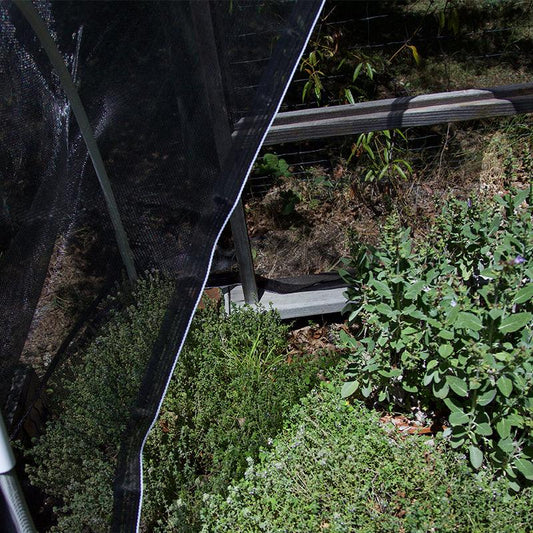
Specific option to evaluate: For Bay Area crops receiving excessive summer solar exposure, the 47% Black Woven Shade Cloth (72" wide, sold by the foot) addresses excessive solar exposure during establishment; 47% is the designed share of light blocked, not a promised temperature reduction. Use it only when crop light needs, measured exposure, root-zone moisture, and airflow indicate that moderate shade is appropriate. Order enough 72-inch-wide material for the canopy plus secure attachment to a suitable frame, allow air space above foliage, and plan access for watering and harvest. Check canopy recovery, leaf color and elongation, root-zone moisture, wind movement, fasteners, and disease conditions beneath the cloth. It cannot correct inadequate irrigation, salinity, root disease, or a crop planted outside its workable season, and excessive shade can reduce photosynthesis. Remove or reduce it when the heat episode or propagation stage ends.
Individual inventory and availability can change. Recheck before purchase. A seed being for sale does not prove that it can mature in a fog-coast pocket, survive an inland heat event, or finish before cold in a basin.
Decide when to start the fall garden
Start the fall crop when its propagation and establishment needs overlap the remaining summer crop—not simply because a month has begun. Count backward from the site's likely temperature and light transition using realistic establishment time, keep a backup, and reserve irrigation capacity. Use the fall garden guide for planting steps and the Bay Area turnover checklist to coordinate shade, harvest, and bed preparation.
A good summer crop plan leaves productive roots where they work, stops asking marginal plants to perform in the wrong microclimate, and begins the next crop while conditions still support establishment. On the coast, heat and leaf wetness may control the choice. Inland, heat and water often lead. In clay, workability can stop the plan; on hills and in frost pockets, exposure and remaining time can. Let those conditions choose the succession.
Carry crop results into the next planting seasons
Use crop performance and succession records to prepare for fall, winter, and spring.
For summer crop timing, compare Southern California, Sacramento–Sierra, and Oregon. Apply only the crop, succession, and protection advice that fits your heat, night temperatures, light, irrigation, and remaining growing window.