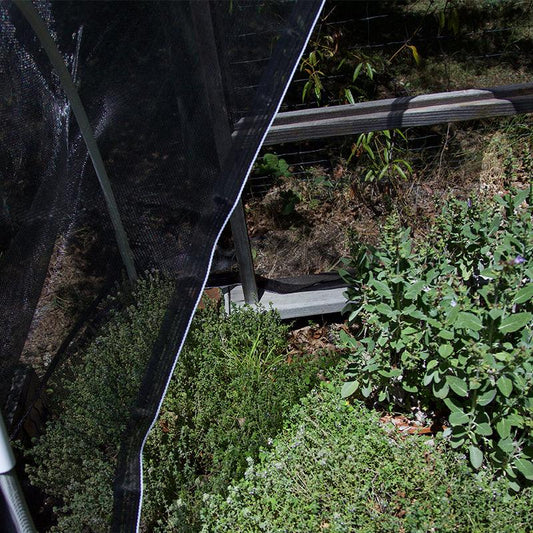
Garden through Sacramento-Sierra summer by managing measured root-zone moisture, overnight crop recovery, heat and smoke forecasts, water reliability and each crop's remaining runway—not by following one regional calendar. Protect people first during extreme heat or smoke. Then keep roots buffered, verify irrigation delivery, decide which beds still justify water and labor, scout before treating and start the next season only when the local window supports it.
For detailed help with individual decisions, see the guides to summer soil cover, crop and succession choices, drip zoning, summer IPM and shade, turnover and perennial operations. Use them to diagnose the limiting condition and choose the next action without overcorrecting.
Start with the regional condition checklist
Walk the garden early, when yesterday's stress and overnight recovery can be compared. Record conditions by hydrozone rather than averaging the whole property.
- People and access: Is outdoor work appropriate under the heat, air-quality, wind and fire-agency guidance that applies now?
- Root-zone moisture: Is soil moist, dry or saturated at active-root depth, not merely at the surface?
- Overnight recovery: Did leaves regain normal posture by morning, or does stress persist?
- Delivery: Do the farthest and highest emitters run, and is pressure visibly different across the zone?
- Wetting pattern: Does water enter the intended root volume without ponding, channeling or running downslope?
- Crop runway: Can the crop reach a useful stage before heat, water limits or the site's likely first frost closes the window?
- Soil cover: Are living roots, retained residue or compatible mulch shading soil without touching trunks or creating an unsafe placement?
- Pest evidence: Are mites, stink bugs, aphids, earwigs or rodents actually present, and is damage increasing?
- Perennials: Are young trees and berries protected at the root zone, supported and receiving water from their own measured zone?
- Open beds: Will the next use be a quick crop, protected fall start, low-water cover or deliberate rest?
- Infrastructure: Can shade, supports and hoses tolerate forecast wind, power interruption and emergency access needs?
- Transition: What observation—not a date—will trigger harvest, bed turnover, fall propagation or erosion preparation?
If safety guidance limits outdoor work, postpone nonessential garden tasks. Irrigation repairs should be planned within current utility, fire and access restrictions. Gardening equipment and vegetation should never obstruct evacuation routes or conflict with local defensible-space requirements.
Separate four Sacramento-Sierra summer tracks
| Segment | Dominant summer constraint | Operating emphasis | Decision that must stay local |
|---|---|---|---|
| Sacramento Valley floor | Extreme heat, warm nights, heavy clay and urban heat storage | Slow irrigation delivery, root-zone shade, overnight recovery and deliberate bed rest | Whether a crop still converts water into useful production |
| Delta-influenced gardens | Cooling influence paired with drying wind | Secure shade and mulch, inspect wind exposure and measure rather than borrowing Valley runtime | Actual evapotranspiration pattern and structural wind load |
| Lower Sierra foothills | Hot sun, dry air, slopes, variable pressure and fire operations | Pressure-compensating zones, contour protection and fire-compatible placement | Whether irrigation infiltrates before moving downslope |
| Higher foothills and frost/snow zones | Shorter remaining season, cooler nights and possible early frost | Count backward from crop maturity, protect perennials and prepare fall soil cover sooner | Remaining usable frost-free runway at this elevation and cold-air position |
Delta cooling does not automatically mean lower irrigation demand when wind strips moisture from exposed beds. A sunny lower-foothill slope may dry faster than a Valley bed, while a shaded canyon pocket can behave differently again. USDA hardiness zones describe average annual extreme minimum temperature; they do not supply a summer planting date, heat threshold or first-frost guarantee.
Use a condition-based summer action timeline
| Trigger | Immediate action | Next decision | Related detail |
|---|---|---|---|
| Forecast heat and poor overnight recovery | Confirm root-zone moisture and delivery; harvest vulnerable produce; postpone stressful work | Repair water, add appropriately ventilated shade or rest the bed | Drip and shade guides |
| Dry root depth despite normal runtime | Inspect filters, pressure, emitters and wetting width | Correct distribution before increasing total application | Drip-zoning guide |
| Surface hot but root zone adequately moist | Check mulch depth, placement and soil cover | Add compatible cover only where it will not create trunk, pest or fire conflicts | Soil guide |
| Crop no longer recovers or lacks maturity runway | Harvest usable produce and remove confirmed problem material | Choose quick succession, protected fall start or deliberate rest | Crop and turnover guides |
| Stippling, distortion, chewing or fruit damage increases | Inspect both leaf surfaces and identify the pressure | Use a threshold-based IPM ladder | IPM guide |
| Smoke, wind, outage or restriction changes access | Follow authorities and stop nonessential work | Stabilize only what can be handled safely and legally | Operations guide |
| Harvest opens a bed | Leave roots or residue where sanitation allows; avoid bare heating | Match cover or crop to water and termination capacity | Soil and crop guides |
| Higher-foothill frost runway becomes short | Compare maturity estimate with local exposure and forecast | Switch crop, use a realistic protective method or stop sowing | Crop guide, then fall plan |
Re-run the relevant line after a heat wave, wind event, smoke episode, irrigation outage or unexpected storm. The next action should answer the changed condition; do not restart every practice or add inputs reflexively.
Sequence the whole garden
- Protect people. Check heat, air quality, fire and local emergency information before field work. Schedule only work that is appropriate under current guidance.
- Measure the root zone. Probe representative beds and perennial zones at useful depth. Surface color is an unreliable watering instruction.
- Restore water delivery. Clean filters as specified, check leaks, compare high and low points and observe wetting after a measured run.
- Keep soil buffered. Retain living roots where the water budget supports them, otherwise use compatible residue or mulch with trunk and defensible-space clearance.
- Triage crops. Favor crops that still recover and have enough runway. Harvest, turn over or rest those consuming water without a realistic outcome.
- Scout and identify. Separate pests from heat, water, smoke, salt and wind injury before intervening.
- Protect perennials and structures. Support loaded branches, secure shade, maintain root-zone cover and avoid major stress-inducing pruning during heat.
- Start the next season. Use local soil temperature, protected-space capacity, harvest timing and remaining frost-free runway to stage fall starts.
The established July gardening guide provides broader task ideas. Use the measurements and thresholds here to decide which task will help your Sacramento-Sierra garden now.
Stabilize soil without creating a fire or trunk problem
Continuous cover can moderate surface temperature and reduce avoidable evaporation, but every cover choice has a water, labor and placement cost. In a producing Valley bed, retained crop roots and residue may be more realistic than establishing a thirsty cover during peak heat. In a higher foothill bed approaching turnover, a short-window cover may fit if establishment water and termination are available.
Keep mulch away from trunks and crowns, inspect beneath it for rodents and irrigation failures and follow current local defensible-space rules. Do not describe one mulch depth or material as universally fire-safe. Buildings, topography, vegetation, prevailing wind and jurisdiction change the acceptable design.
Use mature compost or fertilizer only when a soil test, crop need, site history and product label support it. Organic inputs can add salts or excessive nutrients. They are not a substitute for correcting clogged emitters, compaction, runoff or heat exposure.
Decide whether to maintain production or rest a bed
A summer crop earns continued resources when roots are supplied uniformly, plants recover overnight, the pest burden remains manageable and enough maturity runway remains. A bed may deserve rest when repeated heat injury prevents recovery, water reliability is poor, the crop is past useful production or the higher-foothill frost countdown no longer supports completion.
Rest does not mean bare soil. Harvest, remove confirmed diseased material, retain safe residues or roots and choose a cover compatible with water and future termination. Avoid cultivating Valley clay simply to make an empty bed look finished. Dry pulverized soil can crust, blow or shed water; wet clay can smear and compact.
For fall starts, work backward from desired transplant condition and the receiving bed's readiness. Container size, light, root quality, local heat and the site's likely frost window all matter. A catalog maturity number is an estimate under different conditions, not a promise.
Build resilience with hydrozones, not blanket schedules
Annual vegetables, young trees, established trees, containers and slope plantings should not share a schedule merely because they share a property. Separate zones by crop rooting, soil, exposure, slope and equipment. Measure output or wetting rather than assuming identical emitters deliver identically.
Heavy Valley clay often benefits from slower application or separated pulses when water ponds or runs off, but frequency and duration must be determined from measured depth, plant stage and weather. Foothill slopes require pressure and runoff checks at high and low points. Delta wind can raise exposure while cooler air lowers another part of demand. Inspect the result in the soil.
A controller is a reminder, not a sensor of every bed. Pause or revise programs after leaks, outages, rain, an irrigation restriction or a crop change. Never compensate for poor distribution by endlessly increasing runtime.
Distinguish biological pressure from weather injury
Spider-mite stippling and webbing, stink-bug feeding, aphid colonies, earwig chewing and rodent damage require different responses. Heat scorch, smoke exposure, wind abrasion, salt accumulation and saturated or dry roots can mimic pest symptoms. Inspect patterns across the plant and bed; use magnification where useful; note whether live organisms and fresh injury are present.
Begin with sanitation, exclusion, water correction, habitat and crop support that match the diagnosis. Preserve beneficial organisms and escalate only when monitored damage crosses an acceptable threshold. If a pesticide is justified, confirm the crop and target pest appear on the label, follow all directions and applicable California regulations and account for temperature, bloom, wind and beneficial exposure. No product guarantees prevention or harvest.
Prepare perennials and structures without adding stress
Young fruit trees and berries have limited root systems and should be checked separately from mature plantings. Inspect ties for constriction, support crop load, protect bark from equipment and heat exposure and verify that water reaches active roots rather than the trunk. Keep mulch off bark.
Avoid heavy pruning during extreme heat unless safety or clearly damaged material requires it. Large canopy changes can expose previously shaded bark and fruit. Use clean, appropriate tools and consult the established summer fruit-tree care guide for technique depth.
Secure shade cloth and trellises for local wind, maintain ventilation and plan reuse or disposal. Shade changes light and temperature but can also load structures, reduce airflow or interfere with pollination and access. It is a conditional tool, not a heat-proof guarantee.
Three local decision examples
Valley clay irrigation cycle: Tomatoes wilt in late afternoon but recover by morning. Soil is moist at active-root depth, while the surface is hot. The gardener does not add a blanket watering. They confirm emitter delivery, retain safe mulch, harvest ripe fruit and watch recovery through the forecast heat.
Delta wind exposure: A cooler afternoon still dries a raised bed and moves shade cloth. The gardener measures the root zone, repairs anchors and separates the exposed bed from a sheltered runtime. Wind—not the Sacramento forecast alone—controls the next check.
Lower-foothill slope: Low emitters produce wider wetting while the upper row stays dry. The gardener corrects pressure and layout, uses pulse application only after observing runoff and keeps soil covered along the contour. Adding runtime before distribution repair would waste water downslope.
Connect regenerative practice to a measurable outcome
| Practice | Intended mechanism | Measure | Tradeoff to record |
|---|---|---|---|
| Retained roots or compatible cover | Longer root occupancy and less bare exposure | Covered area, infiltration and next-crop readiness | Establishment water and termination labor |
| Mulch with appropriate clearance | Reduced surface heating and evaporation | Root-zone moisture trend and soil temperature comparison | Imported material, pests and fire placement |
| Hydrozone irrigation | Water matched to soil, crop and exposure | Wetting uniformity, runoff and crop recovery | Equipment, maintenance and plastic life |
| Threshold-based IPM | Fewer unnecessary broad interventions | Pest and beneficial counts plus new damage | Scouting time and crop loss tolerance |
| Soil-test-based nutrients | Inputs tied to documented need | Test trend and crop response | Sampling cost and possible nutrient accumulation |
These are expected mechanisms, not guaranteed results. Use a comparison strip or marked observation points where possible, and record starting conditions so you can judge the outcome later.
Choose supplies only after the decision
After auditing delivery, compare Irrigation & Watering. If verified scouting supports an intervention, review Organic Pest Control and follow the selected label. For a bed with establishment water and a termination plan, consider Year Round Cover Crop Mixes. Where measured exposure warrants a ventilated, securely supported cover, compare Sun Shade Cloths. Recheck availability, instructions, shipping and site fit before purchase.
Close the summer loop
Coordinate household and garden capacity
A resilience plan also has to fit the people maintaining it. During repeated heat or smoke, reduce the number of active zones, harvest earlier in the day when conditions allow and postpone cosmetic work. Group inspections so a gardener can check source, annual beds and young perennials without repeatedly entering extreme conditions. Store records where another person can understand valve locations and priorities.
Set a minimum-maintenance mode before an emergency: which zones protect young perennials, which beds can be rested, how a controller is shut off after a leak and where official utility or fire information is found. Preparing this information in advance does not make garden work appropriate during unsafe conditions. Follow authorities and never remain for garden maintenance when evacuation or closure applies.
Use water and labor budgets together. A crop that requires frequent scouting, hand cooling or repeated replacement shade may not justify continued production. Conversely, a small protected propagation batch can be efficient if it has reliable care and a receiving bed. Record the tradeoff rather than labeling every living-root practice automatically regenerative.
Review the plan after each major event with the person responsible for irrigation. A written exception—such as a disconnected zone, repaired leak or rested bed—prevents a well-intended helper from restoring an obsolete schedule. Date every temporary override and define the observation that will end it.
Keep valve maps, emergency contacts and current priorities together, and review them whenever responsibility changes locally.
Run a weekly field dashboard
A useful dashboard is short enough to complete and specific enough to change a decision. Divide the property into annual beds, containers, young perennials, established perennials and slope or infrastructure zones. For each, assign green, watch or act status from direct observation.
| Field | Green | Watch | Act |
|---|---|---|---|
| Root-zone water | Target volume moist; no runoff | Edge drying or uneven emitter pattern | Dry active roots, saturation, leak or runoff |
| Crop recovery | Normal posture by morning | Slower recovery after event | Persistent wilt, scorch or collapse |
| Soil cover | Protected with safe clearance | Thin, displaced or hiding hardware | Bare heating, trunk contact or unsafe placement |
| Biological pressure | Stable counts and functional beneficials | New hotspot | Confirmed increasing damage over threshold |
| Crop runway | Useful harvest still realistic | Heat/frost margin narrowing | Sequence no longer fits |
| Infrastructure | Secure and serviceable | Wear, load or access issue | Leak, failed anchor or emergency conflict |
“Act” does not always mean add water, spray or purchase material. It can mean stop outdoor work, harvest, repair, remove a dangerous support, protect an outlet or deliberately end a crop. Note which observation changed the status and who will recheck it.
Set priority windows instead of a task calendar
Before forecast heat: confirm safe work timing, distribution, root-zone moisture, harvest readiness and shade anchors. Avoid fertilizing or pruning merely because heat is coming. An input does not replace water delivery and may increase stress.
After the hottest interval: check morning recovery before making major changes. Compare covered and exposed soil, young and established perennials and the beginning and end of drip lines. Allow delayed injury to become visible before removing broad areas.
When a bed opens: decide its next use immediately, but execute only after sanitation, water and runway gates pass. Safe roots or residue can hold soil while a future crop waits.
Before a foothill storm or Valley transition rain: inspect flow paths, stabilize exposed areas and protect stored inputs. Do not work wet clay or destabilize slopes. The first rain may be locally uneven, so verify infiltration and effective depth rather than treating any shower as the end of irrigation season.
As nights cool: separate the higher-foothill frost countdown from continued Valley heat. Move each bed into fall when crop maturity, soil condition and local forecast align.
Keep a one-page field record: heat and smoke conditions, root-zone measurements, overnight recovery, repairs, wetting checks, crop runway, pest evidence, treatment threshold, perennial status and the next trigger for each bed. Photographs from repeatable positions help show whether soil cover, canopy and damage changed.
Move into the Sacramento-Sierra fall plan when harvest and bed openings, cooler soil, the first effective rain or forecast storm create the next real decision. Higher foothills may reach that transition while the Valley is still managing heat. The correct transition is the one the garden demonstrates.
Plan for the next season
When harvest, cooler nights or the first effective rain changes the next decision, use the fall guidance, winter guidance, and spring guidance.
For summer planning in a borderline climate, compare the Bay-Area guidance, SoCal guidance, and Rockies guidance. Apply only advice that matches measurements from your own soil, exposure, forecast, water supply and crop response.