Choose Sacramento-Sierra summer crops by heat recovery, night temperature, measured water capacity and remaining frost-free runway. Heat-tolerant Valley crops are not automatically appropriate for Delta wind or a higher foothill garden, and a short-season catalog description is not a guarantee. Keep only plantings that can establish, mature and be irrigated under the site's actual conditions.
Start by matching your garden to its actual conditions: Sacramento Valley floor, Delta-influenced garden, lower Sierra foothill or higher-elevation frost and snow zone. Valley gardens often need extreme-heat and heavy-clay decisions, while Delta sites can be cooler and windier with different irrigation demand.
Use the regional summer resilience plan to coordinate crop choices with the rest of the garden. Check the soil guide before disturbing a bed and the drip guide before increasing irrigation.
Use a subregional crop and timing matrix
| Segment and condition | Crop strategy | Timing gate | Stop or change when... |
|---|---|---|---|
| Valley floor; warm nights; plants recover | Maintain proven heat-adapted fruiting crops; stage fall starts in protected space | Root-zone moisture and morning recovery remain acceptable | Repeated stress prevents recovery or water cannot be delivered |
| Valley floor; open hot bed | Quick succession only if establishment can be protected; otherwise rest under cover | Soil temperature, water reliability and useful maturity runway | Seedlings cannot establish without excessive inputs |
| Delta-influenced; cooler but windy | Use wind-secure supports and choose crops from measured bed conditions | Wind exposure, root moisture and pollination/fruit-set response | A generic Valley schedule conflicts with local growth |
| Lower foothill; hot dry slope | Concentrate production in reliable hydrozones; choose quick or established crops | Pressure uniformity, access and fire-season water reliability | Runoff or emergency operations make the planting impractical |
| Higher foothill; shortening season | Favor crops whose useful stage fits the local frost runway | Local first-frost likelihood compared with establishment and maturity | The full sequence no longer fits |
| Any segment; smoke or extreme heat | Maintain only essential safe work; protect existing roots | Current official health, heat and fire guidance | Outdoor work is inappropriate |
Diagnose before sowing or transplanting
Check soil temperature at planting depth, root-zone moisture, forecast heat, likely nights, irrigation uniformity and the crop's expected time to a useful harvest. Transplants also need good roots and hardening appropriate to their destination. A protected start can buy flexibility, but it cannot remain indefinitely in a small container without consequences.
Count backward through germination or transplant recovery, vegetative growth and the harvest stage you actually need. Add a buffer for heat, smoke, wind or cooler foothill nights. If the result collides with the site's probable first frost or water limitation, change crop, stage or goal. USDA hardiness zones do not replace this calculation.
Match crop strategy to summer transition
Maintain: Continue an established crop when roots receive water evenly, the canopy recovers overnight, pollination and fruit development remain functional and pest pressure is manageable.
Succession: Use a quick planting when soil, protected establishment, water and harvest runway agree. Choose varieties by independently verified maturity and heat or cold traits; descriptors still need local testing.
Stage fall starts: Propagate in a ventilated, well-lit space that can be protected from extreme heat and wind. Plan the receiving bed before sowing.
Rest: When production is inefficient or the window has closed, harvest, sanitize selectively and keep soil covered. Rest is an intentional crop decision, not abandonment.
Sequence the crop operation
- Inventory producing crops, declining crops, open beds and protected propagation space.
- Measure root-zone moisture and soil temperature in each candidate bed.
- Verify irrigation delivery and the next heat, wind, smoke or frost constraint.
- Compare establishment plus maturity with the local usable window.
- Select maintain, succession, protected start or rest for each bed.
- Prepare only the planting strip needed; retain safe roots and residue elsewhere.
- Harden transplants in steps and install them under a suitable weather window.
- Recheck morning recovery, pests and wetting after establishment.
For measurement technique, use the established guide to soil temperature for starts and seedlings. For broader seasonal sequencing, see Growing a Fall Garden. Use your local soil, weather and water observations to make the final go/no-go decision.
Use crop families without promising performance
In the hottest Valley conditions, established warm-season fruiting crops and locally tested heat-tolerant greens may be candidates if water and overnight recovery support them. Shade may help selected tender crops, but too much shade can reduce flowering or airflow. Run a small comparison before scaling.
Delta-influenced gardens may hold cooler conditions yet face wind abrasion and faster surface drying. Secure supports and observe actual growth rather than importing a downtown Sacramento assumption. Lower foothills often benefit from concentrating crops near reliable pressure-compensated irrigation instead of spreading water thinly across a slope.
Higher foothill choices depend on remaining nights and likely frost exposure. Fast leafy or root crops may fit some sites; fruiting crops may lack runway. Maturity figures are estimates, so test a small planting and keep records by cultivar, elevation, slope aspect and cold-air drainage.
Rotate and inoculate only where the system supports it
Diverse successions can lengthen living-root occupancy and reduce repeatedly growing one crop family in the same bed. Map families and pest history before choosing a succession. Rotation does not guarantee pest or disease prevention, especially when hosts or inoculum persist nearby.
Legume inoculant must match the crop and be stored and applied according to its label. Nodulation and nitrogen contribution depend on biology and conditions; inoculation is not a fertilizer-rate promise. A summer legume that requires more establishment water than the farm can supply is not regenerative for that site.
Protect starts without trapping heat
Shade cloth, insect netting and low structures alter light, airflow and temperature. Support material securely, keep it from abrading foliage and ventilate. Check beneath covers because heat, mites and water failures can progress out of sight. Remove or adjust a cover when the crop response shows it is no longer helpful.
Harden starts gradually to the actual combination of sun, wind and temperature. Avoid transplanting just before an extreme event when a safer window is available. Water the root volume, not the path, and confirm moisture after the first irrigation.
Two local decisions
Valley bed after harvest: A hot raised bed is open, irrigation is reliable but seedlings repeatedly fail to recover. The gardener protects the soil, stages fall starts elsewhere and waits for a measured condition change instead of forcing another succession.
Higher-foothill succession: A packet's maturity estimate appears short, but local nights are cooling and frost exposure is uncertain. The gardener counts the entire establishment-to-harvest sequence, chooses a crop harvested young and sows a small test rather than the whole bed.
Scout crop stress while deciding
Stippling, distortion and dropped flowers can reflect mites, water stress, heat or a combination. Inspect both leaf surfaces, roots and the bed pattern. Stink bugs, aphids, earwigs and rodents require identification and monitored damage, not a routine spray. The summer IPM guide helps you choose a response after the cause and damage trend are clear.
Choose seed and shade after the matrix
When a crop passes the local water, temperature and runway gates, compare All Vegetable Seeds for appropriate candidates. If measured exposure warrants a securely supported, ventilated cover, review Sun Shade Cloths. Verify current inventory, variety traits, instructions and destination fit before purchase.
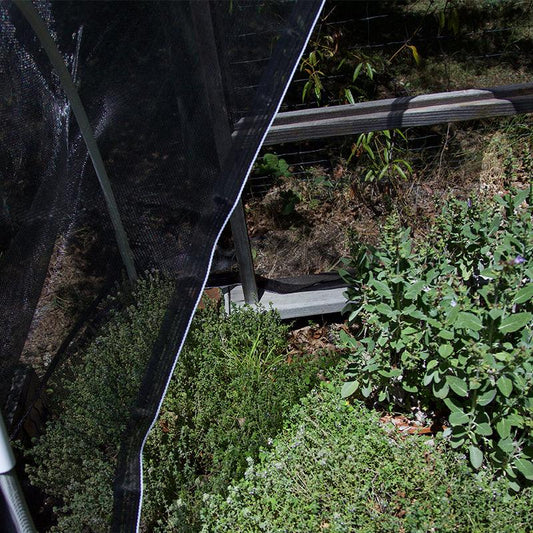
Specific option to evaluate: For Sacramento–Sierra crops receiving excessive summer solar exposure, the 47% Black Woven Shade Cloth (72" wide, sold by the foot) addresses excessive solar exposure during establishment; 47% is the designed share of light blocked, not a promised temperature reduction. Use it only when crop light needs, measured exposure, root-zone moisture, and airflow indicate that moderate shade is appropriate. Order enough 72-inch-wide material for the canopy plus secure attachment to a suitable frame, allow air space above foliage, and plan access for watering and harvest. Check canopy recovery, leaf color and elongation, root-zone moisture, wind movement, fasteners, and disease conditions beneath the cloth. It cannot correct inadequate irrigation, salinity, root disease, or a crop planted outside its workable season, and excessive shade can reduce photosynthesis. Remove or reduce it when the heat episode or propagation stage ends.
Record when to shift toward fall
Pass six planting gates
| Gate | Question | Evidence | If it fails |
|---|---|---|---|
| 1. Safety | Can sowing, transplanting and follow-up occur under current heat, smoke and fire guidance? | Current official conditions and access | Postpone and protect existing plants |
| 2. Root zone | Is the bed workable and able to hold a suitable wetting pattern? | Depth probe, workability and irrigation test | Repair water or wait |
| 3. Establishment | Can seed or transplant be protected through its vulnerable stage? | Temperature trend, hardening, shade and labor | Use protected propagation or change crop |
| 4. Runway | Can the desired harvest fit before limiting heat, frost or water? | Local records plus qualified maturity estimate | Choose an earlier stage or rest |
| 5. Biology | Does rotation and current pest pressure support the crop? | Bed map and scouting record | Use another family or sanitation plan |
| 6. Transition | Can the crop leave the bed ready for the next season? | Harvest, residue and termination plan | Reduce area or choose another use |
All six gates matter. A seed that germinates in warm soil can still fail the runway gate; an available shade cloth does not pass the irrigation gate. Mark the failing gate so a later condition change can reopen the decision without repeating every assumption.
Allocate scarce water and labor deliberately
Rank plantings by establishment investment, perennial value, realistic harvest, water needed to finish and labor required under safe working conditions. Young perennials often require priority because roots are limited, but that priority does not justify flooding their trunks. A declining annual crop may be harvested and ended so water can support a fall start with a better runway.
Concentrating production can improve observation and distribution. One well-zoned foothill block may perform more reliably than scattered plantings across changing elevation. In the Valley, resting the hottest exposed bed can free protected propagation space and labor for the transition.
Include harvest handling in the budget. A crop is not a useful succession if peak harvest arrives when heat or smoke prevents safe picking, cooling or processing. Match planting area to realistic household or farm capacity.
When uncertainty is high, sow in batches rather than committing the whole bed. A later batch can respond to a changed heat or frost runway, while the first batch supplies local establishment evidence.
Label every batch with its intended bed, crop stage and next documented decision trigger.
Use small trials to qualify variety claims
“Heat tolerant,” “short season” and days-to-maturity descriptions summarize performance under particular trials or marketing definitions. They do not guarantee results in a Sacramento heat island, Delta wind corridor or Sierra cold pocket. Verify the variety description, then test a manageable area.
Record emergence, transplant recovery, flowering, first useful harvest, quality under heat, pest burden and water demand. Compare varieties in similar beds when possible. Keep seed-lot and source information. Use this evidence to choose next year's varieties instead of relying on a generic list.
For each bed, log cultivar, sowing or transplant condition, soil temperature, water check, heat and wind exposure, first useful harvest and reason for termination. Compare Valley, Delta and foothill records separately.
The intended outcomes—longer productive root occupancy and more diverse rotation—are not guaranteed. They are evaluated through usable harvest, water and labor cost, pest history, soil cover and whether the next crop enters a ready bed. End the summer crop cycle when those measurements support the fall plan, not when a statewide calendar says it should.
Plan for the next season
When crop maturity, night temperature or frost risk changes, use the fall guidance, winter guidance, and spring guidance.
If your crop window resembles a neighboring climate more closely, compare the Bay-Area guidance, SoCal guidance, and Rockies guidance. Choose from that advice only when local soil, exposure, forecast, water and crop performance support it.