Washington summer IPM begins by separating smoke, heat, water, wind, and salt stress from mites, aphids, foliar disease, slugs, and rodents. Stippled leaves in a hot east-side garden can point toward mites, but drought, chemical injury, nutrient problems, and root damage may look similar. Spots in a humid coastal bed may be biological or environmental. Map the pattern, inspect the organism and root zone, and use a threshold before intervening.
Summer diagnosis begins by separating pests and disease from smoke, heat, water, wind, and salt stress. Use Washington’s summer water-and-resilience plan to coordinate the response. The irrigation guide can help when delivery or moisture is driving symptoms, while the soil guide can help with cover or compaction. Correct identification, protection of beneficial organisms, and measured escalation should determine the next action.
Use a pest-versus-stress diagnostic table
| Pattern or sign | Possible causes | What to verify | First low-disruption move |
|---|---|---|---|
| Fine stippling, bronzing, curling, or webbing | Spider mites; also heat, drought, spray, nutrient, or leaf-surface injury | Inspect undersides with magnification, tap foliage over white paper, compare exposed and sheltered plants, and check moisture | Correct verified water or dust stress, preserve predators, isolate badly affected material when appropriate, and monitor counts |
| Uniform wilt or leaf roll during afternoon heat | Temporary heat response, root-zone deficit, saturation, root disease, wind, or vascular injury | Check early-morning recovery, rooting-depth moisture, emitters, roots, and stem bases | Correct the verified site or water problem; do not automatically irrigate or fertilize |
| Spots, lesions, blight, or mold after leaf wetness | Foliar disease, sunscald, smoke deposits, hail, chemical or physical injury | Examine symptom margins and distribution, weather, crop susceptibility, irrigation, and a diagnostic resource | Improve appropriate airflow and watering practice, remove confirmed problem tissue as recommended, and obtain diagnosis |
| Leaves look dull or coated during smoke | Particles, reduced light, heat, drought, or actual pest/disease injury | Follow air-quality guidance, inspect after conditions improve, and compare leaf surfaces and roots | Postpone unsafe work; do not spray, wash, or feed by appearance alone |
| Distorted tips with clustered soft-bodied insects or sticky residue | Aphids; curling also has non-insect causes | Inspect growing points and undersides, note ants, predators, parasitoid mummies, and growth trend | Monitor small stable colonies; use a directed water stream when crop and disease conditions allow |
| Ragged holes or missing seedlings in moist western cover | Slugs, snails, chewing insects, or physical damage | Scout when active and inspect hiding sites for the organism and fresh evidence | Reduce wet refuges beside vulnerable plants, hand-pick where practical, and monitor |
| Marginal burn, stunting, or a pattern along irrigation lines | Heat, salinity, fertilizer injury, uneven delivery, drought, or root disorder | Compare emitters, soil and water tests where warranted, drainage, and unaffected zones | Stop unsupported inputs and obtain site-specific interpretation |
These are diagnostic paths, not confirmations. Photograph the whole bed and close symptoms, then note crop, variety, stage, root-zone moisture, recent weather, smoke, irrigation, sprays, fertilizers, and distribution. A problem confined to windward edges requires a different investigation from organisms scattered on leaf undersides.
Use a seven-rung IPM escalation ladder
- Protect people. Follow current heat, smoke, fire, and storm guidance; postpone nonessential work when conditions are unsafe.
- Identify. Confirm the crop, symptom, organism or stress, life stage, and distribution. Use WSU Extension or a diagnostic service when uncertain.
- Set a threshold. Consider crop value and stage, damage rate, population trend, beneficial organisms, harvest timing, and replacement options.
- Correct conditions. Repair irrigation, improve appropriate airflow, manage dust, adjust cover, remove severe stress, or improve sanitation.
- Use physical or mechanical tactics. Directed water, hand removal, barriers, pruning of confirmed affected tissue, or monitoring traps may fit specific cases.
- Use biological or chemical tools only when matched. A beneficial organism needs suitable prey and release conditions; a pesticide must be labeled for crop, pest, site, and timing.
- Verify. Recount organisms, inspect new growth, record weather and crop response, and do not repeat automatically.
The organic IPM guide explains how to move from identification to the least-disruptive effective response. In Washington summer, rule out the stressors most likely for the subregion, weather, water system, and crop stage before choosing a control.
Separate four Washington summer patterns
Olympic Peninsula and coast: Cool wind, moisture pockets, leaf wetness, and occasional dry exposed beds can coexist. Foliar symptoms, slugs, and wind abrasion may overlap. Check airflow and roots without stripping protective soil cover.
Puget Sound lowlands: Increasing summer dryness over compacted or glacial soils can stress roots, while shaded irrigated zones remain moist. Aphids, mites, and disease patterns can differ bed by bed. Compare morning recovery and irrigation distribution.
Cascade and high-elevation sites: Cool nights, hail, storms, smoke, and a short season can create abrupt injury. Do not confuse hail or early cold damage with a pathogen. Decide whether a crop can recover before investing in treatment.
Columbia Basin and eastern Washington: Heat, wind, dust, low humidity, and irrigation faults can favor mite problems or mimic them. Salt or fertilizer patterns may also appear at leaf margins. Use magnification and root-zone evidence before responding.
Diagnose mites before treating
Inspect multiple leaves from affected and healthy plants, especially undersides. Look for moving mites, eggs, webbing, and stippling distribution. The spider-mite guide provides identification and management detail. A dusty, water-stressed crop may support faster population growth, but correcting stress does not by itself eliminate an established infestation.
Preserve predatory mites and other natural enemies by avoiding unnecessary broad-spectrum treatments. If a practical threshold is exceeded, compare options in Organic Pest Control by active ingredient, target, crop, site, temperature limits, harvest interval, and pollinator precautions. Follow the current label and Washington requirements.
Handle foliar disease as a diagnosis
Record when symptoms appeared relative to humidity, rain, overhead irrigation, smoke, hail, and heat. Improve spacing or airflow only where crop guidance supports it; do not overprune and expose fruit to sun. Water the root zone when appropriate and avoid unnecessary leaf wetness, but do not claim that drip prevents disease.
Remove confirmed diseased tissue when recommended and clean tools if the pathogen context warrants it. Some disease products must be used preventively and have crop, pathogen, temperature, resistance, or timing limits. Browse Organic Disease Control only after a reliable diagnosis; no treatment guarantees prevention or recovery.
Treat smoke as a safety event first
Use current public-health, air-quality, fire, and evacuation information. Avoid strenuous work and nonessential pesticide application during hazardous conditions. Plant responses depend on smoke duration, particles, light reduction, heat, water, and species. Do not offer a universal washing or harvest-safety rule.
After air improves, inspect actual injury and follow current institutional food-safety guidance if ash or debris affects edible crops. A layer of particles may reduce appearance or light, but washing foliage during heat or using a spray without a target can cause additional harm.
Use shade as conditional weather protection
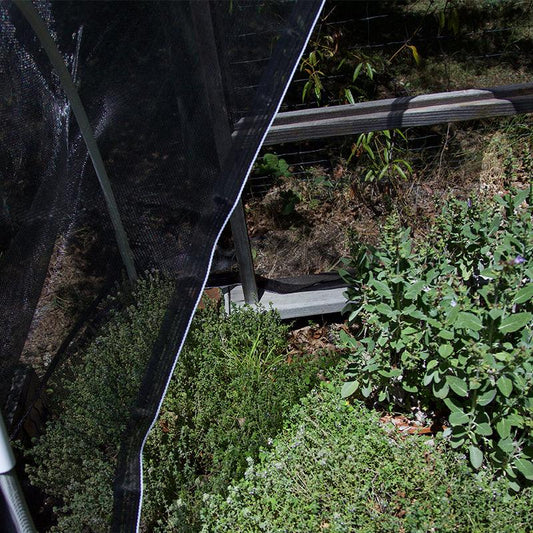
Temporary shade can reduce solar load when the crop, density, height, airflow, support, and removal plan fit. Too much shade can reduce photosynthesis or prolong leaf wetness, and a poorly secured structure can fail in wind. It does not replace measured irrigation or cure mite and disease problems.
If a shade system is justified, compare Sun Shade Cloths by shade percentage, dimensions, durability, attachment, and instructions. Inspect conditions underneath and adjust as weather and crop stage change.
Retain beneficial habitat with boundaries
Flowering plants and structural diversity can supply nectar, pollen, shelter, and alternate prey. The guide to flowers for beneficial insects offers planning depth. Select plants by water, bloom timing, site, and local invasive concerns; do not claim native status without an authoritative geographic source.
Habitat can also compete for water, block airflow, or shelter pests and rodents. Pair it with scouting and targeted sanitation. Beneficial presence does not guarantee pest suppression or harvest.
Decide whether the crop can recover
Compare the damaged leaf area, healthy growing points, root condition, crop stage, remaining season, and value of the harvest. A high-elevation crop approaching frost may not justify repeated intervention, while a young perennial with healthy roots may warrant careful support. Do not force new growth with fertilizer after heat, smoke, hail, or pest injury unless crop need, soil information, and the label support it.
Remove a plant when a confirmed disease, regulated pest, severe structural damage, or declining crop makes removal the safest useful action. Otherwise, avoid stripping every damaged leaf at once; remaining foliage may still support recovery. Use crop- and diagnosis-specific guidance, especially for perennial plants.
Use sanitation and rotation precisely
Remove confirmed infected or heavily infested material when recommended, and dispose of it according to local guidance. Do not assume every symptom belongs in the compost or every residue must leave. Clean tools between affected plants when transmission risk warrants it. Retain clean soil cover and healthy habitat outside the problem zone.
Rotation can reduce repeated exposure to some crop-specific soil problems, but mites, aphids, broad-host pathogens, and windborne inoculum may not respect bed boundaries. Combine rotation with resistant varieties where suitable, healthy planting stock, irrigation and airflow management, weed-host knowledge, and scouting. It is a risk-reduction practice, not a prevention guarantee.
Measure the intervention
Before acting, count organisms or mark symptom boundaries on representative plants. Afterward, return at a defined time that fits the pest life cycle, weather, and tactic. Compare new growth, population, crop function, predators, and any phytotoxicity. A treated leaf will not always look normal again, so judge whether damage stopped and healthy growth resumed.
Record product name and label version when a pesticide is used, along with crop, pest, site, rate, weather, application time, harvest and reentry requirements, and result. This protects against automatic repeat applications and helps evaluate the decision later.
Close the summer scouting loop
- Map symptom distribution and an unaffected reference.
- Inspect roots, stems, both leaf surfaces, irrigation, and actual organisms.
- Record heat, smoke, rain, wind, hail, humidity, inputs, and crop stage.
- Set a threshold based on trend and crop consequence.
- Correct verified water, airflow, dust, cover, or sanitation problems.
- Protect predators, parasitoids, pollinators, soil, and clean water.
- Follow the entire label and applicable regulations for any pesticide.
- Recheck on a defined interval and measure new growth or population change.
The safest Washington summer IPM plan is evidence first. Western moisture and eastern heat are useful hypotheses, not diagnoses. Confirm what is injuring the crop, protect people and beneficial organisms, then climb only as high on the ladder as the verified problem requires.
Keep scouting as summer conditions change
Use the Washington fall IPM guide to prepare for slugs and rodents, the winter IPM guide to diagnose storage and dormant-season problems, and the spring IPM guide to separate pest damage from frost stress.
If your site behaves more like a neighboring region, compare Oregon summer IPM guidance, cold-climate summer IPM guidance, and Rockies summer IPM guidance. Use only the advice that fits your soil, exposure, forecast, water, crops, and pest evidence.