Time Sacramento-Sierra shade, harvest turnover, fall starts and perennial care from current heat, wind, smoke, water and frost-runway conditions. Secure infrastructure before forecast wind, protect roots and trunks without trapping moisture, harvest and cover beds without unnecessary cultivation and avoid major perennial work during extreme stress unless safety requires it.
Use the regional summer resilience plan to coordinate seasonal decisions. Use the crop guide to choose a succession with enough runway and the IPM guide to diagnose pests before treating.
Use the operations checklist
- Check current heat, air-quality, wind, fire and emergency-access guidance before work.
- Inspect shade anchors, supports, ties, netting and loaded branches.
- Verify young-perennial root-zone moisture separately from established trees.
- Keep mulch and irrigation hardware away from trunks and crowns.
- Harvest ripe or vulnerable produce before a forecast extreme event when safe.
- Remove only confirmed diseased, infested or unsafe material.
- Leave safe roots or residue protecting an open bed.
- Stage fall starts only when protected-space and receiving-bed capacity agree.
- Prepare foothill contours and drainage before effective rain without exposing soil.
- Clean, dry and repair tools before storage; replace only failed components.
- Record skipped work and the condition that will reopen it.
- Maintain evacuation and defensible-space clearances under local rules.
Perennial go/no-go decision table
| Operation | Go when... | Wait or limit when... | Primary check |
|---|---|---|---|
| Support loaded limb or cane | Hardware can be installed without bark constriction | Heat/smoke makes work unsafe or support transfers load poorly | Attachment, wind and crop weight |
| Adjust root-zone mulch | Material can shade soil with trunk/crown and fire clearance | Rodents, saturation or local placement rules conflict | Bark, moisture and hidden emitters |
| Selective sanitation cut | Material is confirmed damaged/diseased and cut is justified | Diagnosis is uncertain or large canopy loss would expose bark | Tree condition and forecast heat |
| Major pruning | A crop-specific plan and suitable seasonal condition support it | Extreme heat, active stress or sunscald exposure is likely | Species, objective and canopy response |
| New fall start | Propagation space and future transplant window are ready | Containers will outgrow space before receiving bed opens | Root quality, light, heat and frost runway |
| Foothill erosion preparation | Cover can be installed safely without bare interval | Slope is unstable or engineering is required | Flow path and first effective storm |
Separate local operations
Sacramento Valley floor: Prioritize shade stability, harvest before quality declines, young-tree water and avoiding major canopy or soil disturbance during extreme heat.
Delta-influenced gardens: Wind load controls shade and trellis decisions. A cooler forecast does not excuse loose anchors or abrasion. Inspect ties and edge drying.
Lower foothills: Coordinate crop turnover with pressure checks, fire operations and contour protection. Keep emergency routes clear and avoid creating a loose bare slope before storms.
Higher foothills: Fall and frost preparation can arrive earlier. Count from the site's likely frost exposure and snow load; do not copy the Valley's turnover pace.
Sequence shade and support work
- Define the crop or bark exposure problem that shade or support must solve.
- Check wind, structure rating, anchor points, ventilation and worker access.
- Install or adjust during safe conditions without constricting stems or trunks.
- Observe plant temperature, posture, flowering and airflow after the change.
- Remove or revise material when it causes abrasion, excessive shade or heat trapping.
- Label reusable pieces, repair them and store them dry at the end of service.
Shade cloth changes radiation; it does not guarantee frost, heat or harvest protection. Trellises and ties need capacity for wind and mature crop load. Reused material can reduce waste when it remains sound, but degraded plastic or frayed netting should not be trusted.
Turn over beds without leaving bare heat
Harvest usable produce, identify any pest or disease problem and remove only material that should not remain. Leave healthy roots in place when they do not obstruct the next crop. Retain compatible residue or add cover based on water, sanitation, rodents and fire-safe placement.
Do not till heavy Valley clay for appearance. In the foothills, do not strip cover from a slope just before likely storm runoff. If a fall crop is not ready, define an interim cover and its exit plan.
Stage fall starts from capacity
Protected propagation should have enough light, ventilation, water reliability and container volume. Count backward from the receiving bed's condition rather than from a generic sowing date. Higher foothill starts need a realistic frost runway; Valley starts need protection from heat that can impede establishment.
Harden seedlings in steps to their actual destination. If smoke, wind or extreme heat interrupts the sequence, hold only while roots and containers remain suitable. A delayed transplant is not improved by allowing it to become root-bound.
Protect perennials without overpruning
Check young trees and berries at active-root depth. Confirm emitters have not become buried or left beside the trunk as the root system expanded. Inspect ties, guards and supports for rubbing or constriction. Keep mulch off bark.
During severe heat, delay major pruning that could expose previously shaded bark or fruit unless safety requires work. Sanitation cuts still require correct identification and tool hygiene. Use the established guides for bare-root and first-year tree care and fruit-tree pruning. Cultivar hardiness, chill and dormancy needs must be verified individually.
Prepare foothill soil for the next effective rain
Trace where water will enter, concentrate and leave. Protect contour and outlets with compatible cover before the storm window without damming water against structures. Clean only drains and channels that are meant to convey flow, and dispose of debris safely.
Severe erosion, retaining walls or unstable slopes require qualified assessment. Garden mulch is not an engineering repair. Maintain defensible space according to current local rules; no vegetation arrangement is universally fire-safe.
Operate during smoke, outages and restrictions
Official emergency, health and utility guidance outranks the garden plan. Avoid nonessential outdoor work when heat or air quality makes it inappropriate. Do not obstruct access or run equipment contrary to restrictions.
After an outage, confirm pump, timer and controller status before assuming schedules resumed. Triage young perennials and small containers from measured need, then repair distribution. Record what the system could and could not maintain; that evidence should inform future zoning or backup planning.
Two local examples
Delta wind: Shade cloth protects lettuce at midday but snaps against foliage and lifts a support. The gardener removes it before the next wind event, reinforces a properly rated frame and retests a smaller ventilated panel.
Higher-foothill turnover: A bed opens while the Valley remains hot. Local nights are cooling and first-frost runway is short. The gardener chooses a protected quick crop for part of the bed and establishes erosion-ready cover on the rest, retaining roots until the next operation.
Choose infrastructure after the go/no-go check
If a crop or perennial needs a properly rated structure, compare Plant Support. Where measured exposure warrants a ventilated cover, review Sun Shade Cloths. For a justified clean cut, compare Pruning & Cutting Tools. Confirm live availability, specifications and site fit before purchase.
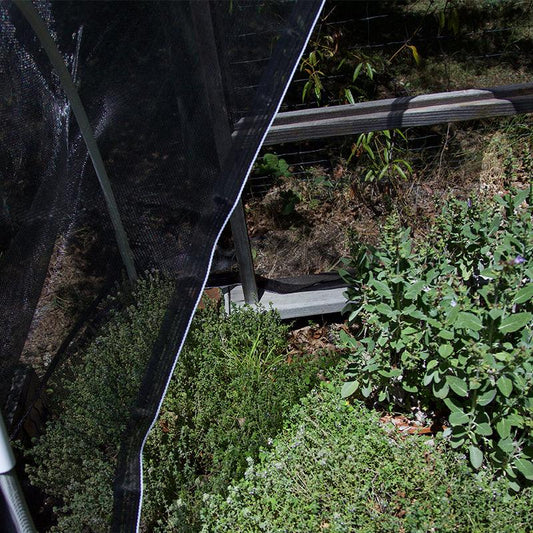
Specific option to evaluate: For Sacramento–Sierra shade infrastructure, the 47% Black Woven Shade Cloth (72" wide, sold by the foot) is appropriate only after the shade percentage, span, wind exposure, and removal plan are defined. Its function is to reduce incoming solar radiation; it can also reduce photosynthesis or airflow if placed too densely or too close to foliage. Size the order for the 72-inch fabric width and required length, support it above the canopy where practical, tension it on a structure that can carry the wind load, and keep irrigation and harvest access open. Inspect anchors, abrasion, sagging, canopy temperature, root-zone moisture, and crop response after heat or wind events. Shade cloth is not a substitute for adequate water delivery, and it should be removed, cleaned, stored, reused, or retired when conditions or material integrity no longer justify it.
Close the operations record
Maintain tools and structures as a regenerative practice
Extending service life can reduce replacement waste when equipment remains safe. Clean soil and sap from tools using a method appropriate to the material, sharpen or service cutting edges according to manufacturer instructions and dry metal before storage. Do not mix chemicals or improvise disinfectants; when sanitation is needed, follow current crop-disease and product guidance.
Inspect wooden stakes for rot, metal for sharp bends, netting for entanglement and plastic for ultraviolet degradation. Retire components that cannot carry the expected wind or crop load. Sort reusable pieces by dimensions and label their last use so next season's installation is efficient.
Shade and support systems should be designed for removal as well as installation. Avoid single-use fastening where a durable, plant-safe alternative meets the load. Reuse is beneficial only when the material does not abrade stems, harbor a confirmed problem or fail structurally.
Turn harvest cleanup into a clear seasonal transition
Before removing a crop, decide where usable produce, seed, healthy residue and problem material will go. Note pest and disease history for the rotation record. Check whether irrigation layout will serve the next planting or should be capped, moved or repaired.
Then leave the bed in a stable state: roots retained where compatible, surface protected, paths intact and no standing water or loose erosion source. Anyone caring for the garden should be able to see the bed's condition and know what should happen next without guessing what was removed.
Label propagation trays, stored supports and covered beds with the same destination name. That simple link prevents a fall start from being separated from its soil, irrigation and frost constraints.
Record the bed's last crop family and any confirmed pest or disease. The label helps you choose rotation and sanitation without reconstructing summer history.
Date the record.
Use an event-response card
| Event | Safety first | Garden triage | Recheck |
|---|---|---|---|
| Extreme heat | Limit work under current guidance | Young roots, containers, water faults and loaded branches | Morning recovery |
| Delta wind | Avoid unstable structures | Remove/secure shade, ties and loose material | Abrasion and anchors |
| Smoke/fire operations | Follow authorities and access rules | Only essential safe stabilization | System status after clearance |
| Power or water outage | Use equipment lawfully and safely | Prioritize measured vulnerable zones | Pumps, timers and distribution |
| Foothill storm | Stay out of unsafe flow and slopes | Protect outlets; document rills | Drainage and cover |
Log structure inspections, repairs, material reuse, harvest completion, sanitation, covered area, propagation batches, perennial water checks, pruning rationale and the next fall trigger. Photograph support attachments and repeatable canopy views.
The intended outcomes—higher perennial survival probability, less infrastructure waste, safer turnover and protected soil—are not guarantees. They are evaluated through plant recovery, equipment life, covered soil and a smooth transition to the Sacramento-Sierra fall plan.
Plan for the next season
As heat, wind, harvest and frost conditions change, use the fall guidance, winter guidance, and spring guidance.
If your wind, heat or frost exposure resembles a neighboring climate more closely, compare the Bay-Area guidance, SoCal guidance, and Rockies guidance. Adapt any structural or seasonal advice to local soil, forecast, water, crop response and current safety requirements.